
BESS Noise Assessment Checklist: PCS, HVAC, Site Boundary and Testing
Noise is easy to underestimate when a commercial battery energy storage system looks quiet during a daytime walk-through. The sound profile can change with state of charge, power setpoint, ambient temperature, cooling demand, fan speed, operating mode and the number of units running together. A useful BESS noise assessment checklist therefore starts with operating conditions and site receptors, not with a single brochure sound value.
This guide is for project owners, EPC teams, consultants and buyers comparing an outdoor BESS cabinet, containerized system or hybrid installation. It explains what to ask for before procurement, how to plan a field survey, which records belong in FAT and SAT, and how to keep equipment data separate from a local planning or environmental approval decision.
1. Start with the project noise question
Define the decision before requesting measurements. A planning submission may need predicted sound levels at a property boundary or sensitive receptor. An owner may instead need to confirm that a new installation does not create a tonal complaint at a nearby office, workshop or residence. An EPC contractor may need a repeatable acceptance record for each operating mode.
Write the question in one sentence and record the responsible party. For example: “Can the proposed BESS operate at the required dispatch output without exceeding the project’s approved receptor criterion?” The criterion itself must come from the applicable permit, planning condition, lease, local rule or consultant brief. Do not copy a limit from another country or assume that an equipment datasheet is a legal approval.
2. Map the site before selecting equipment
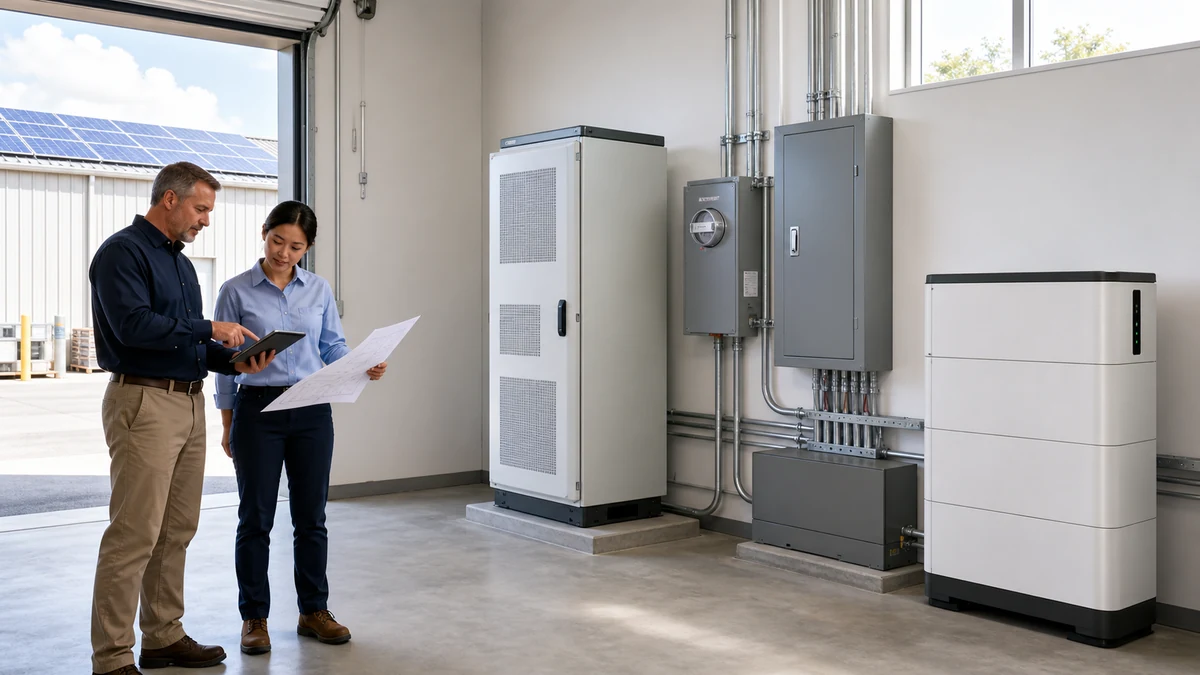
Mark the BESS footprint, PCS, transformers, HVAC discharge, standby generators, fire pumps, access roads and future expansion area on a site plan. Then mark receptors: property lines, offices, residences, schools, hospitals, worker rest areas and any location where people may reasonably expect lower background sound.
Distance alone is not enough. A hard wall, roof edge, fence, elevated platform or reflective façade can change the acoustic path. A site with several cabinets may also create a combined source even when each cabinet is acceptable on its own. Ask the supplier for a simple equipment layout and identify which surfaces or barriers were assumed in any prediction.
3. Identify every likely BESS sound source
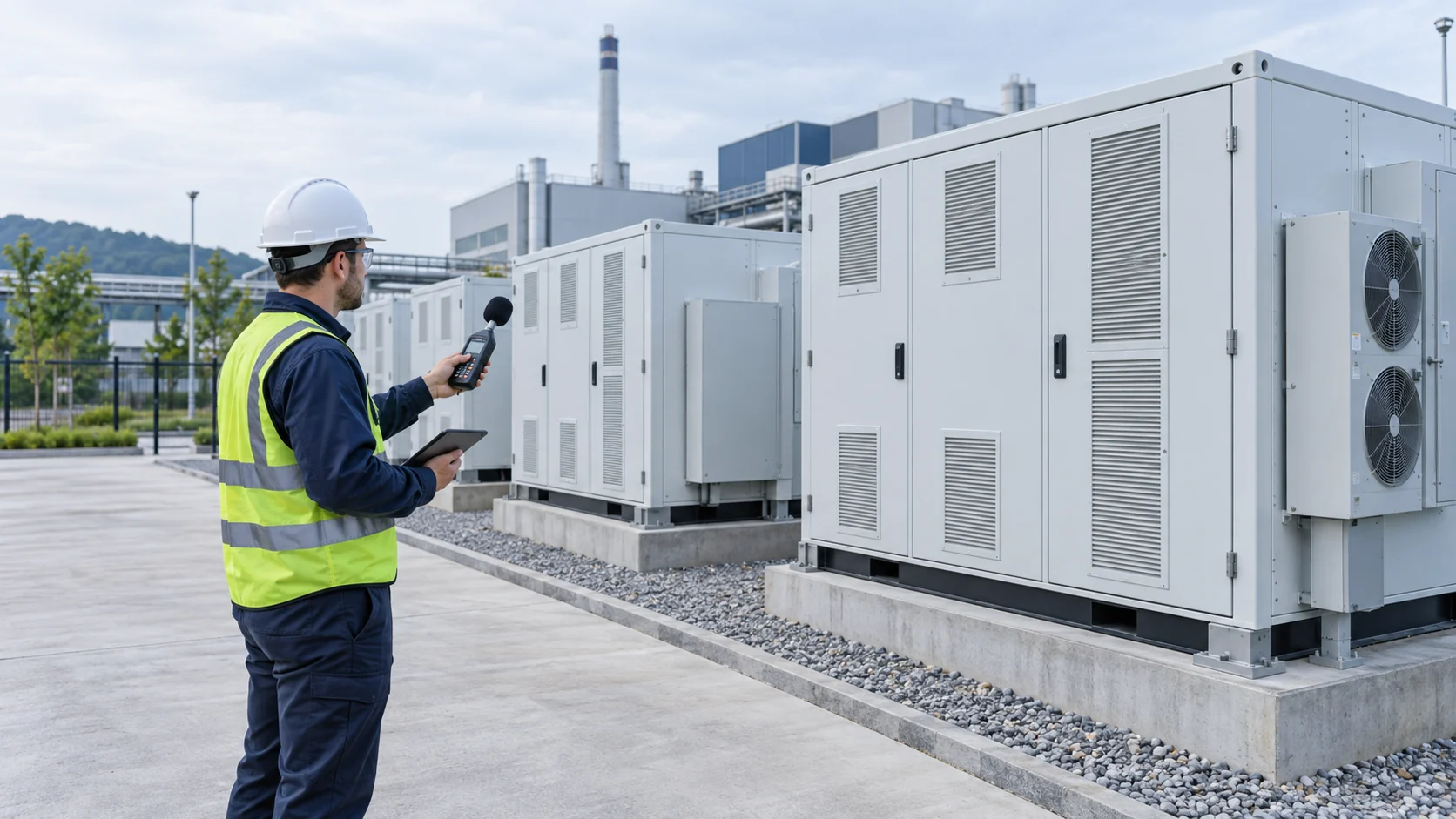
Battery cells are not usually the dominant airborne sound source during normal operation. The practical checklist should focus on the equipment that moves air, converts power or starts and stops mechanically:
- PCS fans, inductors and switching-related tonal components.
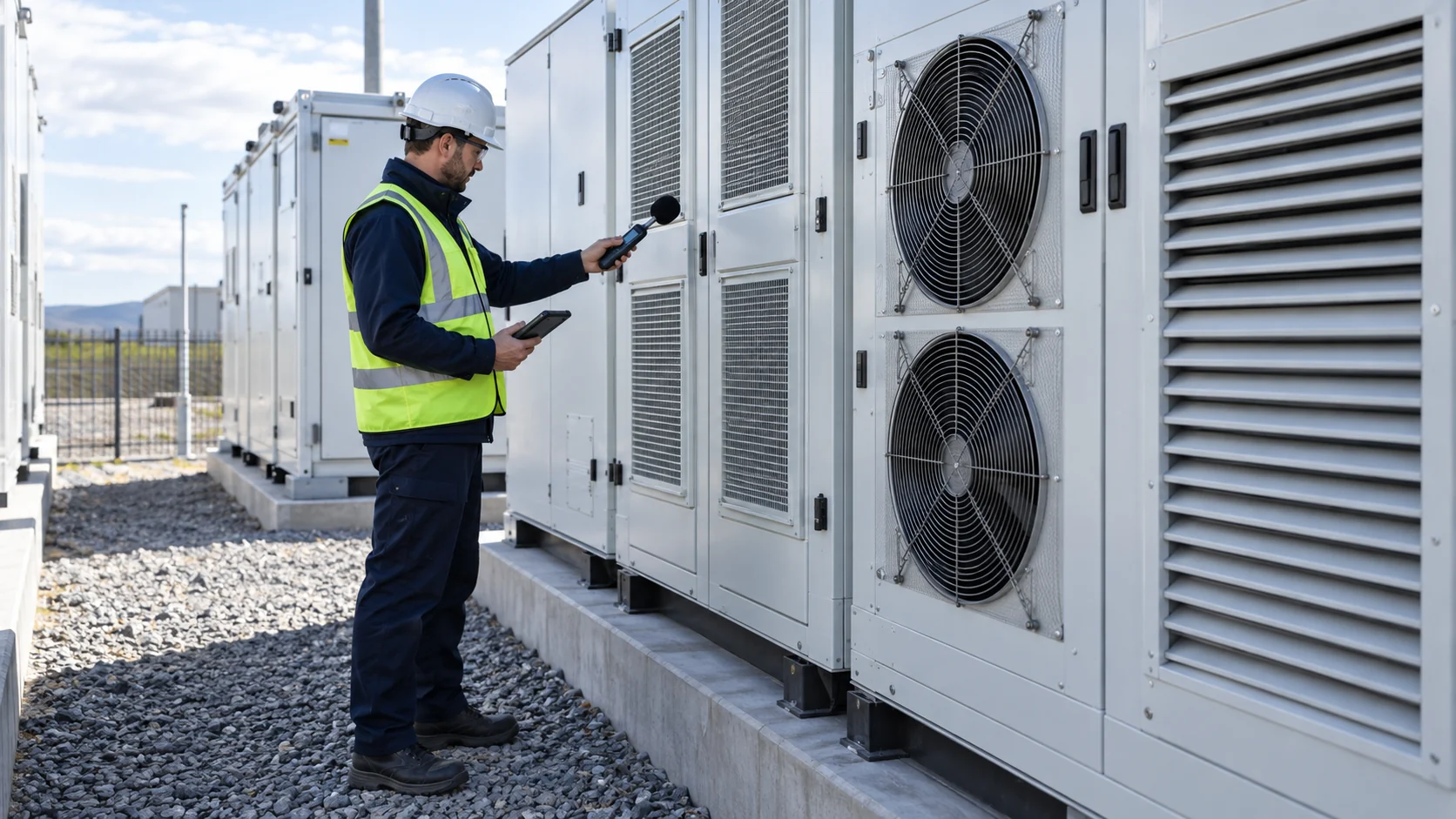
- Battery cabinet HVAC compressors, condenser fans and supply or exhaust grilles.
- Container HVAC, circulation fans and emergency ventilation paths.
- Transformers, auxiliary power equipment and medium-voltage switchgear cooling.
- Diesel generators, fire pumps or other backup equipment that may run during testing.
- Vehicle movements, doors, alarms and maintenance activity that should not be confused with steady-state equipment noise.
For each source, request the location, operating state, octave-band or frequency information where available, test distance, test environment and whether the value is sound power or sound pressure. These terms are not interchangeable.
4. Ask for comparable supplier data
A supplier comparison is meaningful only when the measurement basis is comparable. Add these fields to the request-for-quotation schedule:
| Field | What to request | Why it matters |
|---|---|---|
| Source definition | Cabinet, PCS, HVAC, transformer or complete system | Prevents a quiet battery enclosure from being compared with a complete operating block |
| Operating point | Charge, discharge, idle, standby and thermal-management state | Noise can change with load and temperature |
| Measurement basis | Sound power or sound pressure, weighting, distance and test standard | Allows a consultant to use the value correctly |
| Frequency information | Octave bands or tonal notes where available | Helps assess tonal or low-frequency concerns |
| Configuration | Number of cabinets, PCS units, transformers and spacing | Combined sources may dominate the site result |
| Conditions | Ambient temperature, fan mode, doors closed and alarm state | Defines what the reported value actually represents |
5. Separate sound power from sound pressure
Sound power describes the acoustic energy emitted by a source under a defined test method. Sound pressure is what a microphone receives at a particular position and is affected by distance, reflections, barriers and weather. A supplier’s sound-pressure value at one metre should not be pasted directly into a boundary prediction without checking the test setup.
When a quotation includes only one number, ask for the test report or measurement note behind it. If the number is an estimate, label it as an estimate. Keep the source data, propagation model and receptor result as three separate rows in the project record.
6. Plan operating scenarios, not one snapshot
A credible survey covers the scenarios that could create the highest practical exposure. At minimum, consider full or near-full discharge, high-rate charging, idle with HVAC active, hot-weather cooling, cold-weather heating if fitted, one block operating, all blocks operating and any automatic fan ramp. Include planned maintenance and commissioning tests when they may affect neighbors.
Record the dispatch setpoint, battery state of charge, HVAC status, PCS status, number of active units and time of measurement. If the project has a noise criterion for night-time operation, schedule a representative night scenario rather than extrapolating from a quiet afternoon.
7. Choose measurement points carefully
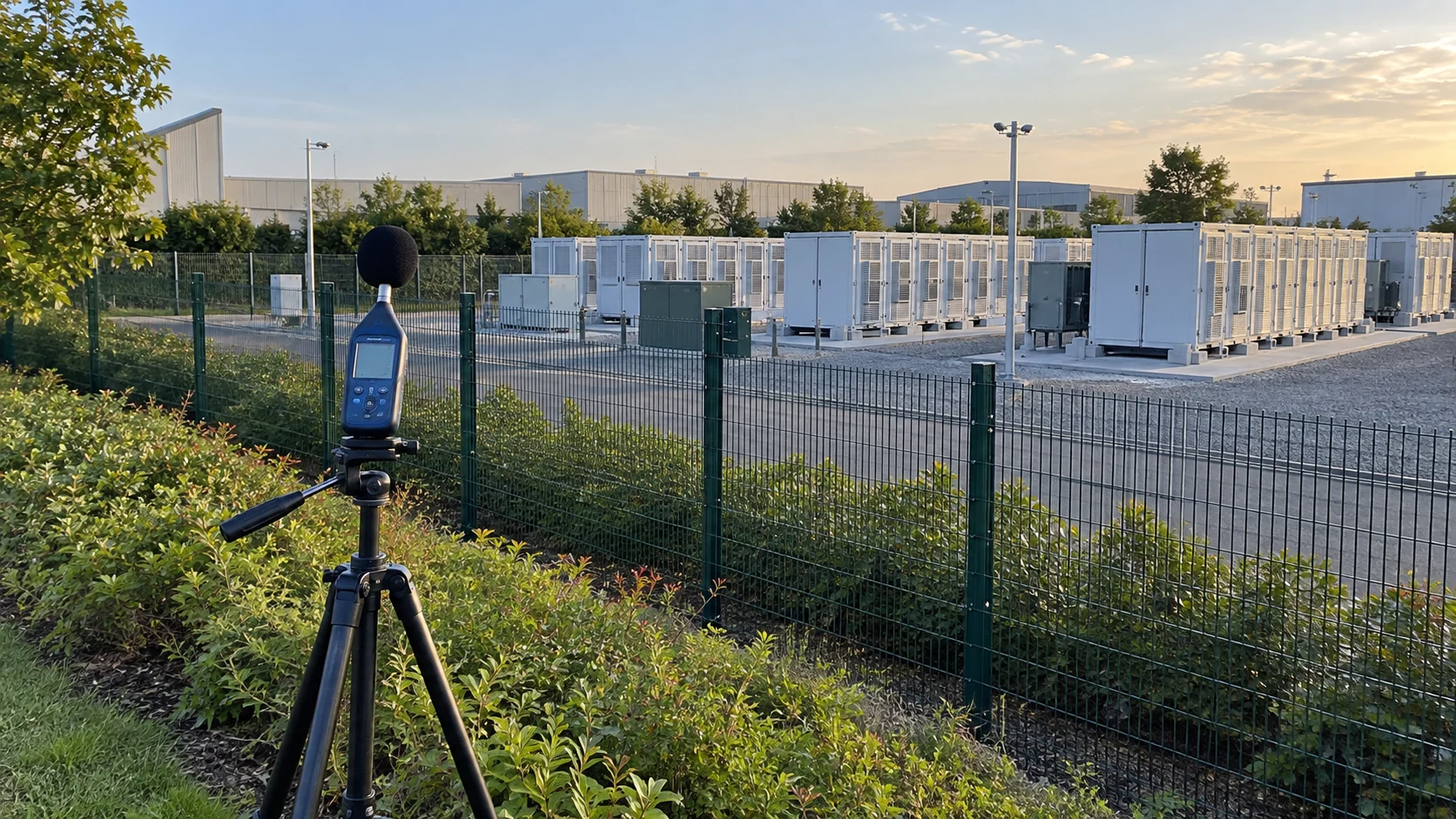
Measurement points should answer the project question. Use source-level points to diagnose a cabinet or PCS. Use boundary or receptor points to assess the combined site. Document microphone height, distance to the nearest source, ground surface, barriers, weather, wind direction and nearby activities.
Do not place a microphone in an unsafe operating zone just to obtain a lower number. The electrical, thermal and fire-safety plan controls access. If a point cannot be safely occupied, document the alternate position and the reason for it. A repeatable safe measurement is more useful than an isolated number collected without a defensible setup.
8. Control weather and background sound
Wind, rain, wet surfaces, insects, traffic, construction and neighboring machinery can change a field result. Note the weather and background activity for every run. Use a windscreen and follow the instrument manufacturer’s operating guidance. Where possible, obtain a background run with the BESS in the relevant off state, then repeat the same point with the selected scenario active.
Background correction, averaging period and statistical descriptors should be selected by the qualified acoustic professional for the jurisdiction and project brief. The buyer’s job is to preserve the raw data and assumptions, not to force a preferred result.
9. Put noise checks into FAT and SAT
FAT documents should state which equipment is tested, which loads are simulated, whether HVAC is enabled and how the instrument is calibrated. SAT should verify the installed arrangement: cabinet spacing, barriers, doors, fan settings, cable routes, transformer position and the actual operating modes available in the control system.
Ask for before-and-after records if an acoustic louver, barrier, low-noise fan setting or enclosure treatment is introduced. A mitigation item is not closed merely because it appears on a drawing; it needs an installed reference and a repeatable operating condition.
10. Review cooling, airflow and maintenance together
Noise and thermal performance can conflict. A louver, barrier or acoustic enclosure may restrict airflow or increase heat rejection demand. Review the cooling design, clearances, filter access, fan replacement path and alarm logic alongside the acoustic proposal. The same topic belongs in the maintenance plan: dirty filters, worn bearings, loose panels and blocked airflow can change both temperature and sound.
For background on air-cooling choices, compare the related air-cooling versus liquid-cooling buyer checklist and keep the selected cooling assumptions in the equipment schedule.
11. Define mitigation and responsibility
Possible controls include relocating a source, changing orientation, selecting a lower-noise operating mode, adding a barrier, treating a louver or setting a night-time dispatch limit. Every control needs an owner, drawing reference, performance assumption, maintenance requirement and verification method. Avoid vague language such as “low noise design” without a test basis.
The supply contract should state whether the vendor provides source data only, a complete acoustic prediction, a mitigation design, field testing or all of these. The owner, EPC, acoustic consultant and equipment supplier should not each assume that another party owns the receptor assessment.
12. Build a handover record that can be reused
Keep the approved layout, source data, operating scenarios, instrument certificates, raw files, weather notes, calibration checks, photos, deviations and corrective actions in one controlled handover folder. Link the record to the BESS commissioning package and O&M plan. A future replacement fan or additional cabinet can then be assessed against the original assumptions instead of starting from memory.
For related project controls, see the C&I battery commissioning checklist, the ESS maintenance checklist and the C&I ESS manufacturer checklist.
Buyer questions to send with an RFQ
What should the supplier provide?
Request a source list, test basis, operating scenarios, frequency information where available, layout assumptions, cooling state, warranty boundary and a named contact for acoustic questions. Ask the supplier to identify values that are measured, calculated or provisional.
Can a datasheet guarantee compliance?
No. A datasheet can support a design, but compliance depends on the installed configuration, operating mode, propagation path, receptor and applicable approval criterion. A qualified local assessment and field verification may still be required.
What if no noise data is available?
Record the gap as a procurement risk. Request a representative test, a conservative engineering estimate with assumptions, or a contractual deliverable before equipment is accepted. Do not invent a number to complete a comparison table.
Should battery safety and noise be reviewed separately?
They should have separate technical checks but one coordinated site plan. Safe access, fire separation, ventilation, emergency operation and acoustic barriers can affect one another.
When should the buyer involve an acoustic consultant?
Involve one when a permit, sensitive receptor, tonal concern, night operation, multiple source types or a disputed field result is present. The consultant can define the metric and method before the RFQ locks in unsuitable data.
Reference points for a defensible project file
Use the project’s local rules and permit first. For occupational noise topics inside the work area, consult the UK Health and Safety Executive noise-at-work guidance. For environmental noise policy background, review the U.S. EPA Noise Pollution and Abatement Act overview. These references do not replace local planning requirements or a project-specific acoustic assessment.
FAQ: BESS noise assessment checklist
What is the first item in a BESS noise assessment checklist?
Define the receptor, operating scenario and applicable project criterion before comparing equipment values. This prevents an unqualified datasheet number from being treated as a site approval.
Which BESS components usually need a noise review?
Review PCS equipment, HVAC compressors and fans, container ventilation, transformers, auxiliary equipment and any generator or fire-pump test that may operate near a receptor.
Is a sound-pressure value at one metre enough for a boundary decision?
Usually not. The test method, source definition, frequency content, distance, reflections, barriers, weather and the combined installation must be understood before a boundary or receptor result is predicted.
What should be saved after the BESS noise survey?
Save the layout, operating states, instrument and calibration records, raw measurements, weather and background notes, photos, deviations, mitigation actions and the final verification conclusion.
For a project-specific storage configuration, share the site layout, load profile, operating schedule, receptor map and required handover evidence with the SolarStorageHub team through the contact page.
Related SolarStorageHub Resources
If you are turning this article into a buying decision, compare the relevant product families and send your inverter model, target capacity, installation country, and quantity plan for confirmation.