
Unstable Power Supply in Factories: ESS Checklist for Voltage Dips and Outages
An unstable power supply in a factory can appear as voltage dips, brief interruptions, repeated equipment trips, generator transfer problems or complete outages. The correct response depends on the disturbance: a UPS, voltage conditioner, generator and battery energy storage system solve different problems. Start with measured event data and a critical-load list before requesting equipment.
This guide is for factory owners, EPC teams, distributors and energy-storage buyers preparing a power-quality or backup project. It does not replace a site investigation, protection study or electrical design by qualified local professionals. Use it to organize evidence, compare solution boundaries and prepare a clearer quotation request.
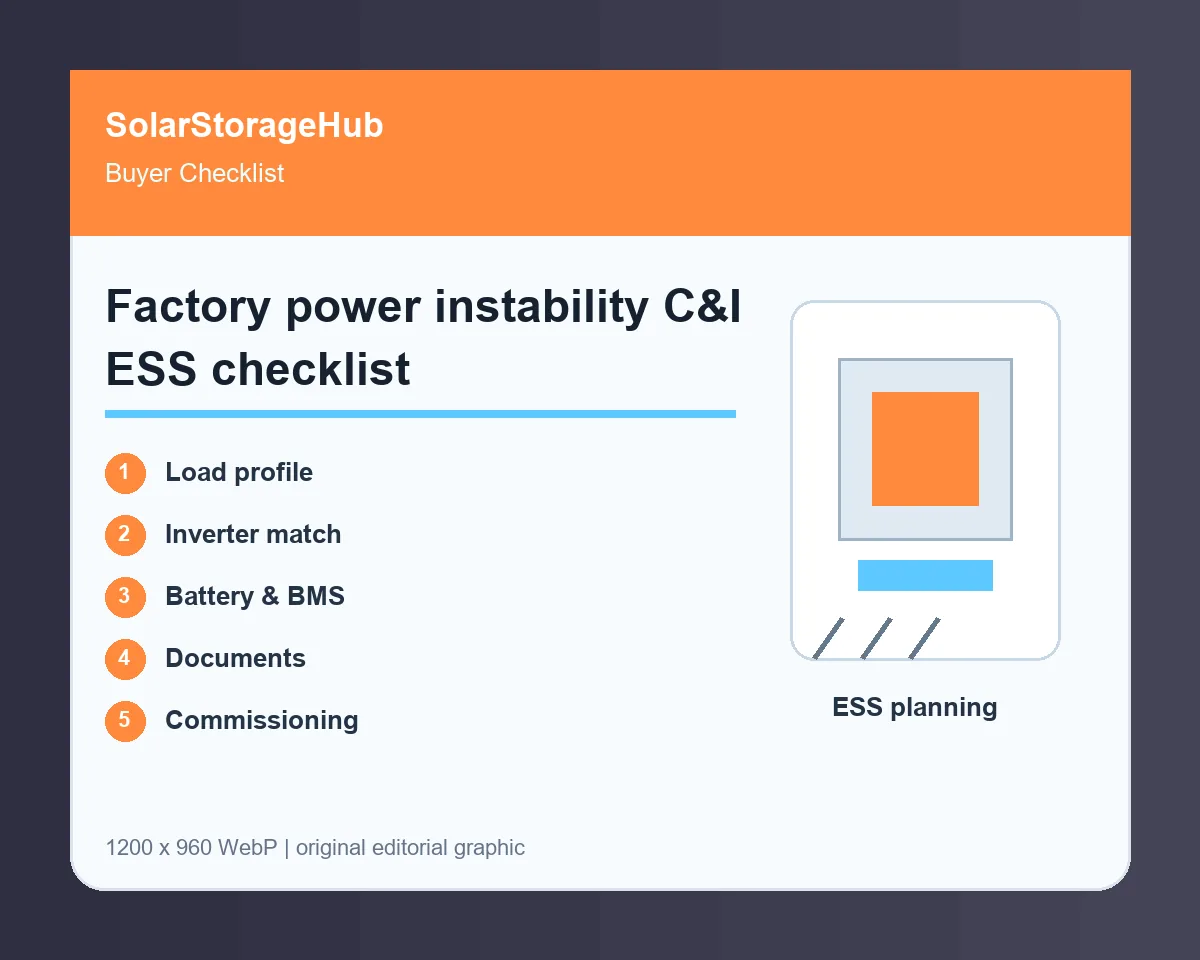
Record the disturbance before selecting equipment
“Unstable power” is not a single specification. Ask the site team to record when each event happens, how long it lasts, which phases and loads are affected, and what alarms appear. A power-quality analyzer, utility record, protective-device log, generator controller log and equipment event history may reveal different parts of the problem.
| Observed event | Evidence to collect | Questions before selecting a solution |
|---|---|---|
| Short voltage dip | Minimum voltage, duration, phase affected and machine trip log. | Is the event caused by the grid, a motor start, transformer loading or internal wiring? |
| Brief interruption | Event duration, frequency, transfer behavior and critical controls affected. | Must the load operate without interruption, or is a controlled restart acceptable? |
| Long outage | Outage history, required backup hours, fuel availability and restart sequence. | Which loads need UPS continuity, ESS runtime or generator support? |
| Repeated breaker or drive trip | Trip code, current, voltage, harmonics, temperature and protection settings. | Is the cause supply quality, overload, motor starting, equipment condition or coordination? |
| Generator instability | Frequency, voltage, step-load response, controller log and transfer record. | Can the generator, UPS and PCS operate together under the required modes? |
What causes unstable power supply in a factory?
Possible causes include a weak utility feeder, overloaded transformer, undersized cable, loose connection, unbalanced phases, large motor starts, rapidly changing loads, harmonics, incorrect protection settings, generator-control problems and weather-related grid events. Several causes may occur at the same site, so buying a battery before measuring the disturbance can produce the wrong result.
Begin with safe inspection and measurement by qualified personnel. Compare utility-side events with internal switchboard and machine logs. If only one production line trips, the problem may be local. If the whole facility sees the same voltage event, the incoming supply, transformer or large shared load deserves closer review. Any damaged equipment, overheating, arcing or unsafe wiring requires immediate professional attention.
Match the technology to the power event
A single product should not be expected to correct every disturbance. Define the response time, power, duration, permitted interruption and operating mode for each critical load, then compare the available technologies.
| Technology | Typical role | Important limitation to confirm |
|---|---|---|
| Surge protective device | Limits specified transient overvoltage when correctly selected and installed. | It does not provide backup energy or correct every sustained voltage problem. |
| Voltage regulator or conditioner | Supports loads through an approved input-voltage range. | Response range, capacity, bypass behavior and compatibility must match the load. |
| Online UPS | Provides fast continuity and conditioned power for controls, servers and other no-break loads. | Runtime and overload capability may be too limited for large production loads. |
| Generator | Supports longer outages when fuel, maintenance and start logic are available. | Start delay, step-load response, emissions, noise and interaction with UPS or PCS need review. |
| Battery ESS | Supports backup, peak shaving, solar self-consumption and controlled load support. | PCS response, transfer arrangement, battery current, usable kWh and grid mode must fit the event. |
When battery energy storage helps—and when it does not
A properly designed C&I battery energy storage system can supply selected loads during outages, reduce demand peaks, absorb surplus PV energy and coordinate with a generator or energy-management system. It can also create time for a controlled shutdown when the grid fails.
Battery storage does not automatically repair unsafe wiring, incorrect protection, severe harmonics or every fast voltage transient. Grid-connected PCS equipment may also be required to stop operating during a grid failure unless the system includes an approved backup architecture. Ask for a single-line diagram, operating-mode description and transfer sequence rather than assuming that a quoted battery cabinet provides uninterrupted backup.
Size the ESS from critical loads and event duration
Separate critical production loads from comfort and deferrable loads. Record continuous kW, starting or surge demand, operating sequence, acceptable interruption and required runtime. A preliminary usable-energy estimate starts with critical-load kW multiplied by backup hours, then accounts for conversion losses, SOC reserve, temperature, aging and any generator or PV contribution. Final sizing must use the actual load profile and equipment limits.
- Power: maximum simultaneous kW, motor starts, phase balance and required overload duration.
- Energy: expected outage duration, usable kWh, reserve SOC and restart strategy.
- Battery limits: charge/discharge current, temperature, cycle profile, BMS alarms and warranty conditions.
- Site limits: transformer capacity, grid voltage, switchgear, space, cable route, ambient conditions and fire-safety requirements.
- Control: grid-connected mode, backup mode, generator coordination, PV operation, export limit and load shedding.
Use the C&I ESS site survey checklist to organize site evidence before requesting final capacity and price.
Check motor starts, PCS overload and battery current together
Factory motors, compressors, pumps and transformers can demand high current during energization. The PCS must support the agreed power and overload duration, while the battery and BMS must permit the required DC current. An inverter overload figure is not useful unless its duration, temperature conditions and repeatability are documented.
Ask whether large loads will start directly, through a variable-frequency drive or in a controlled sequence. Confirm what happens if the demand exceeds the PCS limit: voltage drop, current limit, alarm, bypass, generator start or shutdown. The C&I ESS PCS sizing checklist covers kW/kWh ratio, reactive power and transformer limits in more detail.
Define generator, PV and transfer behavior
Where a generator already exists, document start delay, minimum loading, step-load capability, frequency and voltage range, synchronization rules and fuel runtime. The EMS may need to start the generator at a reserve SOC, limit battery charging, prevent reverse power and manage the return to grid supply. These functions should be described in the quotation and tested at site.
If PV is included, confirm whether it can operate during backup, how generation is curtailed when the battery is full, and where meters or current transformers are installed. Control ownership must be clear among the PCS, EMS, generator controller, PV inverter and transfer equipment.
Turn the design assumptions into commissioning tests
Commissioning should test the operating modes that justified the project. Agree on safe test conditions, responsible personnel and acceptance criteria before energization.
- Verify meter and CT direction, phase sequence, communication and time synchronization.
- Record grid voltage, frequency, load kW, battery current, SOC and temperature during representative operation.
- Test the agreed transfer, load-shedding, generator-start and return-to-grid sequence.
- Confirm PCS power limits, overload behavior, reserve SOC, alarms, emergency stop and communication-loss response.
- Save settings, firmware versions, alarm logs, trend data and signed acceptance records for warranty support.
Carry the design record into the C&I battery energy storage commissioning checklist. For broader technical context, see the U.S. Department of Energy energy storage resources.
What to send before requesting a factory ESS quotation
Send the installation country, grid voltage and frequency, single-line diagram, transformer and generator details, interval load data, event records, critical-load list, required interruption time, backup hours, motor-start information, PV size, site layout, ambient conditions, communication requirements and target commissioning date.
SolarStorageHub can compare battery, PCS, EMS, cooling and project-support assumptions before quotation; final power-quality diagnosis, protection coordination and electrical design remain with the responsible local parties. Submit the available project package through Contact.
FAQ
Can an ESS fix an unstable power supply?
An ESS can support defined backup and load-management functions, but it does not correct every voltage, harmonic, wiring or protection problem. Measure the disturbance and define the required operating mode first.
What is the first step when factory voltage is unstable?
Record voltage, frequency, duration, affected phases, load state and equipment alarms, then have qualified personnel separate utility-side events from internal electrical causes.
Should every factory load be backed up?
Usually not. Separate safety, control and production-critical loads from deferrable loads so the backup system is sized around real continuity needs.
Is a UPS the same as a battery ESS?
No. A UPS is commonly selected for fast, no-break continuity and conditioned power. A larger ESS may serve longer backup, peak shaving, PV integration and energy management, depending on its architecture.
Why do motor starts matter for ESS sizing?
Starting demand may exceed normal running power. PCS overload capability, battery current, voltage behavior and the motor-start method must be checked together.
What evidence should be kept after commissioning?
Keep approved drawings, settings, firmware versions, test records, alarm logs, load and battery trends, training records and warranty handover documents.
Related SolarStorageHub Resources
If you are turning this article into a buying decision, compare the relevant product families and send your inverter model, target capacity, installation country, and quantity plan for confirmation.