
C&I ESS PCS Sizing Checklist: kW/kWh Ratio, Overload, Reactive Power and Transformer Limits
Engineering review note: Battery capacity in kWh does not determine how much instantaneous power a C&I ESS can deliver. The power conversion system, battery current limits, transformer, switchgear, grid connection and operating mode all constrain usable kW and kvar. A quotation that lists only battery kWh can leave the buyer with a system that has enough energy but cannot perform the intended task.
This checklist is for EPC teams, distributors, facility owners and project developers comparing C&I ESS, Solar Inverter, Solar Panel, and larger Home Energy Storage systems. Use the Battery Storage Buyer Resources hub and submit the load profile, single-line diagram and service requirement through Contact.
Why PCS sizing is not a simple kW-to-kWh ratio
A 500 kWh battery paired with a 100 kW PCS is a five-hour system at rated power before losses and reserve limits. Pairing the same battery with a 250 kW PCS changes the theoretical duration to two hours. Neither configuration is automatically correct. The answer depends on peak duration, backup loads, PV charging, demand response, grid limits, battery C-rate, ambient temperature and future expansion.
The project team should define the required power profile over time. That profile may include continuous discharge, short overload, motor starting, reactive power, charging power and ramp rate. Each requirement should be matched against both PCS capability and battery-side current limits.
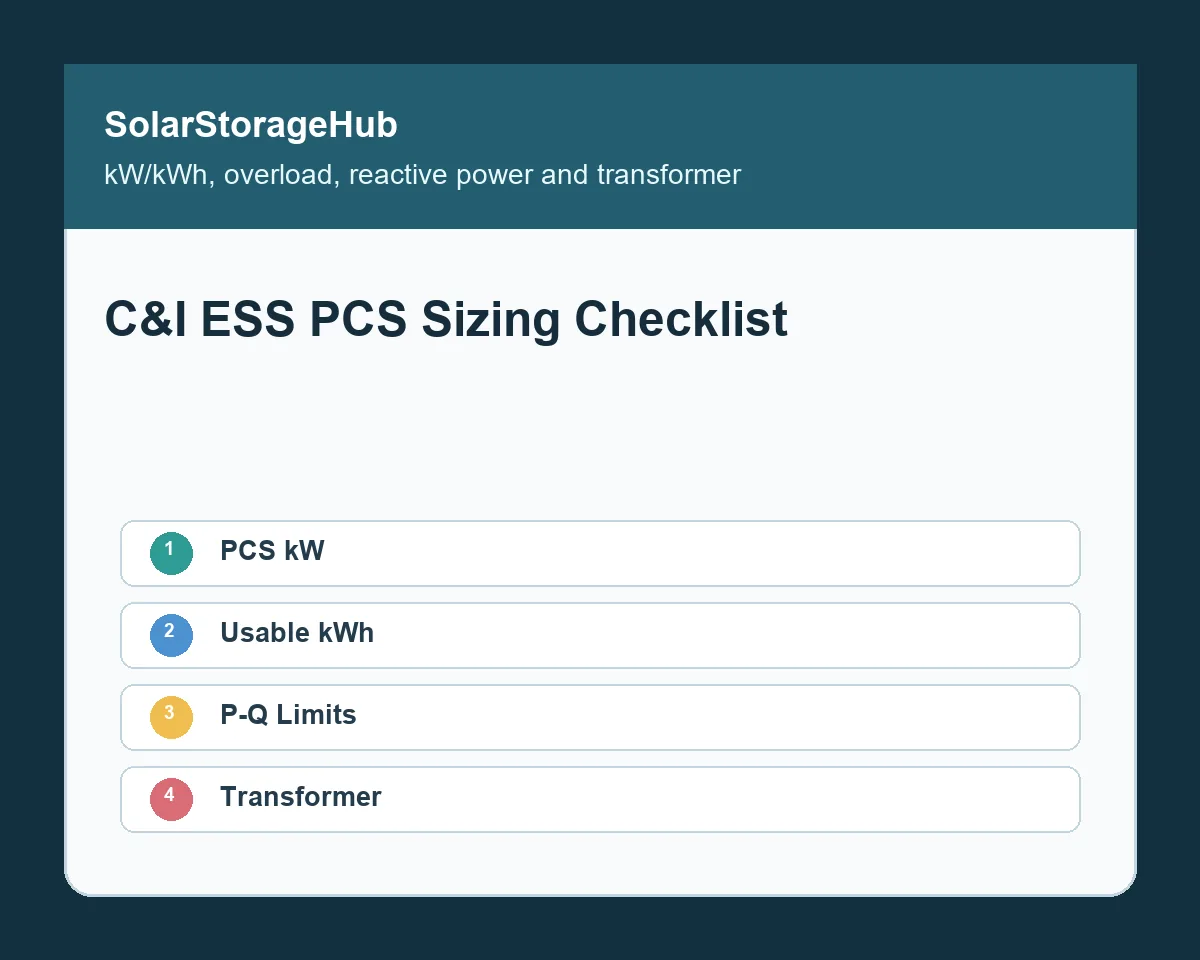
C&I ESS PCS sizing checklist
| Check area | What to confirm | Why it matters |
|---|---|---|
| Service profile | Peak shaving, backup, PV smoothing, tariff charging, demand response or multiple services. | Defines when active power and energy are required. |
| Continuous kW | PCS output at site voltage, temperature, altitude and expected power factor. | Prevents nameplate power from being overstated. |
| Overload | Permitted overload percentage, duration, recovery and repetition limit. | Supports motor starts and short process peaks. |
| Battery current | Maximum continuous and peak charge/discharge current across the SOC and temperature range. | Confirms the battery can support PCS demand. |
| Reactive power | kvar requirement, apparent-power limit and whether active power is reduced while supplying kvar. | Avoids double-counting PCS capacity. |
| Transformer | Voltage ratio, kVA, impedance, vector group, inrush, losses and protection coordination. | Connects PCS output safely to the site. |
| Grid connection | Export limit, import limit, fault level, anti-islanding and utility settings. | Determines permitted operating envelope. |
| Expansion | Future battery racks, PCS modules, transformer capacity and switchgear space. | Prevents an early design decision from blocking growth. |
Start with the required service profile
Write the project objective as a time-based operating requirement. For peak shaving, identify the target grid demand, peak duration and number of events. For backup, list critical loads, starting currents and required duration. For PV self-consumption, compare midday surplus with evening load and charging limits.
The C&I ESS Peak Shaving Data Checklist explains the interval data and tariff information needed for demand management. The C&I ESS Quote Checklist covers the broader site and commercial evidence package.
Calculate power and usable energy separately
PCS kW answers how much active power can move at one moment. Usable battery kWh answers how long that power can be sustained within the permitted SOC window. Calculate both and include conversion loss, auxiliary consumption, reserve SOC, temperature derating and expected degradation.
A battery may support rated PCS power only over part of its SOC or temperature range. Ask for the battery's maximum charge and discharge current curve, not one headline value. At low SOC, high temperature or low temperature, the BMS may reduce current before the PCS reaches its own limit.
Check apparent power and reactive power obligations
PCS equipment is often rated in kVA as well as kW. When the unit supplies or absorbs reactive power, the available active power may decrease because the combined apparent power cannot exceed the converter limit. A project that expects full active-power discharge and significant kvar support at the same time needs this relationship stated clearly.
Request the P-Q capability curve, allowed power-factor range and operating conditions. Confirm whether the grid operator requires voltage control, fixed power factor, reactive power at zero active power or another mode. These requirements should be included in the control and acceptance test plan.
Review overload and motor-start requirements
Continuous rating and overload rating are different. A PCS may allow a higher output for seconds or minutes, but only under specified temperature, SOC and repetition conditions. For backup systems with pumps, compressors or transformers, obtain starting current or measured event data and compare it with PCS overload, battery current and transformer behavior together.
Do not use an overload value as a permanent operating point. If the site repeatedly exceeds continuous rating, the system may derate, trip or accumulate thermal stress. Load sequencing, soft starters or a larger PCS may be more appropriate, subject to the responsible electrical design.
Match the battery DC window to the PCS
The PCS must operate across the battery's actual DC voltage range, including maximum charge voltage, normal discharge range and minimum permitted voltage. Series configuration, cell count, SOC, temperature and BMS contactor logic affect this window. Buyers should ask for a battery-to-PCS compatibility record for the exact configuration.
Communication should include allowable charge current, allowable discharge current, SOC, state of health, alarms and contactor status. If CAN or another interface fails, define whether the PCS stops, derates or uses voltage fallback. The BMS Parameters Buyer Checklist helps structure this review.
Include transformer and switchgear limits
A PCS cannot be sized independently from the transformer and AC distribution. Check transformer kVA, voltage ratio, impedance, cooling, ambient temperature, harmonic performance, inrush, vector group and protection. Switchgear, cables and busbars should be rated for continuous current, fault level and the selected installation method.
Transformer and PCS losses also affect usable system efficiency and thermal design. Ask whether quoted auxiliary loads include HVAC, controls, fire systems and standby consumption. These loads reduce the energy available at the point of connection, especially during long low-power operation.
Confirm charging power and grid constraints
Discharge power is only half the operating cycle. The system needs enough charging opportunity to restore SOC before the next event. Check PV surplus, grid import limit, tariff windows and battery charge-current limits. A high-power PCS does not guarantee high charging power if the grid connection or battery limits are lower.
For sites with export restrictions, confirm CT or meter location, control response, fail-safe behavior and permitted transient export. The Hybrid Solar Inverter Commissioning Checklist covers CT direction and export-limit testing; larger projects need the same logic documented at the appropriate metering and controller level.
Plan modularity and future expansion
Modular PCS equipment can improve serviceability and staged expansion, but the design still needs shared AC and DC limits. Ask whether modules can operate independently, how redundancy is managed, what happens during maintenance and whether future modules require control, transformer or switchgear changes.
Battery expansion also needs an approved age, firmware and SOC strategy. Do not assume that additional racks can be connected years later without review. Reserve physical space, cable routes, communication capacity, protection positions and transformer margin only when the project plan supports them.
Turn calculations into acceptance tests
The quotation assumptions should become commissioning checks. Test meter direction, PCS charge and discharge commands, active-power limit, reactive-power mode, ramp rate, export control, reserve SOC, alarm response, communication loss and emergency stop. Where safe and permitted, verify a representative continuous-power period and an agreed overload event.
Save settings, waveforms or trend logs, battery current, DC voltage, temperatures, SOC and point-of-connection power. Use the C&I Battery Energy Storage Commissioning Checklist and C&I ESS Maintenance Checklist to carry the design record into operation.
For broader technical and safety context, project teams can review the U.S. Department of Energy energy storage resources and UL Solutions energy storage system testing and certification.
What to send before requesting a PCS quotation
Prepare the interval load profile, service objective, required backup loads, target kW and duration, PV size, grid voltage, phase configuration, import and export limits, transformer details, ambient temperature, altitude, site single-line diagram and future expansion plan. State any reactive-power or utility requirement separately.
SolarStorageHub can compare the supplied power, energy and equipment assumptions before quotation; final grid studies, protection coordination and electrical design remain with the responsible local parties. Submit the project package through Contact.
After defining PCS kW and usable kWh, compare those requirements with the outdoor battery storage cabinet configuration and cost factors. View the product and buyer checks.
Related buyer guide: Container size should be checked together with PCS power, transformer limits and overload requirements. Read 20ft vs 40ft BESS Container: Capacity, Layout, Shipping and Commissioning Checklist.
Related buyer guide: Manufacturer review should include PCS sizing, transformer limits and overload behavior. Read C&I ESS Manufacturer Checklist: Factory Evidence, Documents and Warranty.
Related buyer guide: PCS power and transformer limits are major cost drivers in outdoor cabinet ESS projects. Read Outdoor Cabinet Energy Storage System Cost Checklist.
Related buyer guide: PCS sizing controls peak shaving behavior, overload margin and transformer requirements. Read Outdoor AC Energy Storage Cabinet Checklist: Cooling, IP Rating and PCS.
Related buyer guide: PCS sizing should be checked against kW, kWh, overload behavior and transformer limits. Read 40ft BESS Container Checklist: Layout, PCS, HVAC and Site Handover.
Related buyer guide: PCS scope and transformer limits should be confirmed before FAT and commissioning. Read C&I ESS Factory Audit Checklist: Manufacturing, FAT and Warranty.
Related buyer guide: PCS sizing should be checked against kW/kWh ratio, overload behavior and transformer limits. Read Outdoor ESS Cabinet Manufacturer Checklist: Cost, Cooling and Evidence.
Related buyer guide: PCS sizing affects container layout, transformer assumptions and commissioning risk. Read 20ft Energy Storage Container Checklist: 40ft BESS Layout and HVAC.
FAQ
What is the difference between PCS kW and battery kWh?
PCS kW is instantaneous power capability. Battery kWh is stored energy available over time within the permitted SOC and operating limits.
Can a larger battery compensate for an undersized PCS?
It can extend runtime but cannot increase AC power beyond the PCS, battery current, transformer and connection limits.
Why does reactive power reduce active power?
Active and reactive power share the PCS apparent-power limit. The exact tradeoff is shown by the equipment's P-Q capability curve.
Should PCS overload rating be used for normal operation?
No. Overload is limited by duration, temperature and repetition. Normal operation should remain within the continuous rating.
Does PCS charge power always equal discharge power?
Not necessarily. Firmware, battery current, grid limits, PV availability and equipment design can produce different charge and discharge limits.
What data is needed to size a PCS for peak shaving?
Use interval load data, tariff rules, target demand, peak duration, charging window, battery limits and reserve requirements.
What should be tested during PCS commissioning?
Test metering, commands, power limits, reactive mode, ramp rate, export control, communication loss, alarms, reserve SOC and emergency stop.
Related SolarStorageHub Resources
If you are turning this article into a buying decision, compare the relevant product families and send your inverter model, target capacity, installation country, and quantity plan for confirmation.