
AC-Coupled vs DC-Coupled Home Battery Retrofit: Solar, Backup and Inverter Checklist
Retrofit note: Choosing AC-coupled or DC-coupled battery storage is not only an efficiency comparison. Existing PV equipment, inverter ownership, backup expectations, export controls, meter location, warranty boundaries and local approval requirements can make one architecture much easier to install and support than the other.
This guide is written for homeowners, distributors, installers and project buyers comparing Home Energy Storage, Solar Inverter, Solar Panel, and smaller C&I ESS systems. Use it with the Battery Storage Buyer Resources hub, then send the existing solar equipment list and backup loads through Contact.
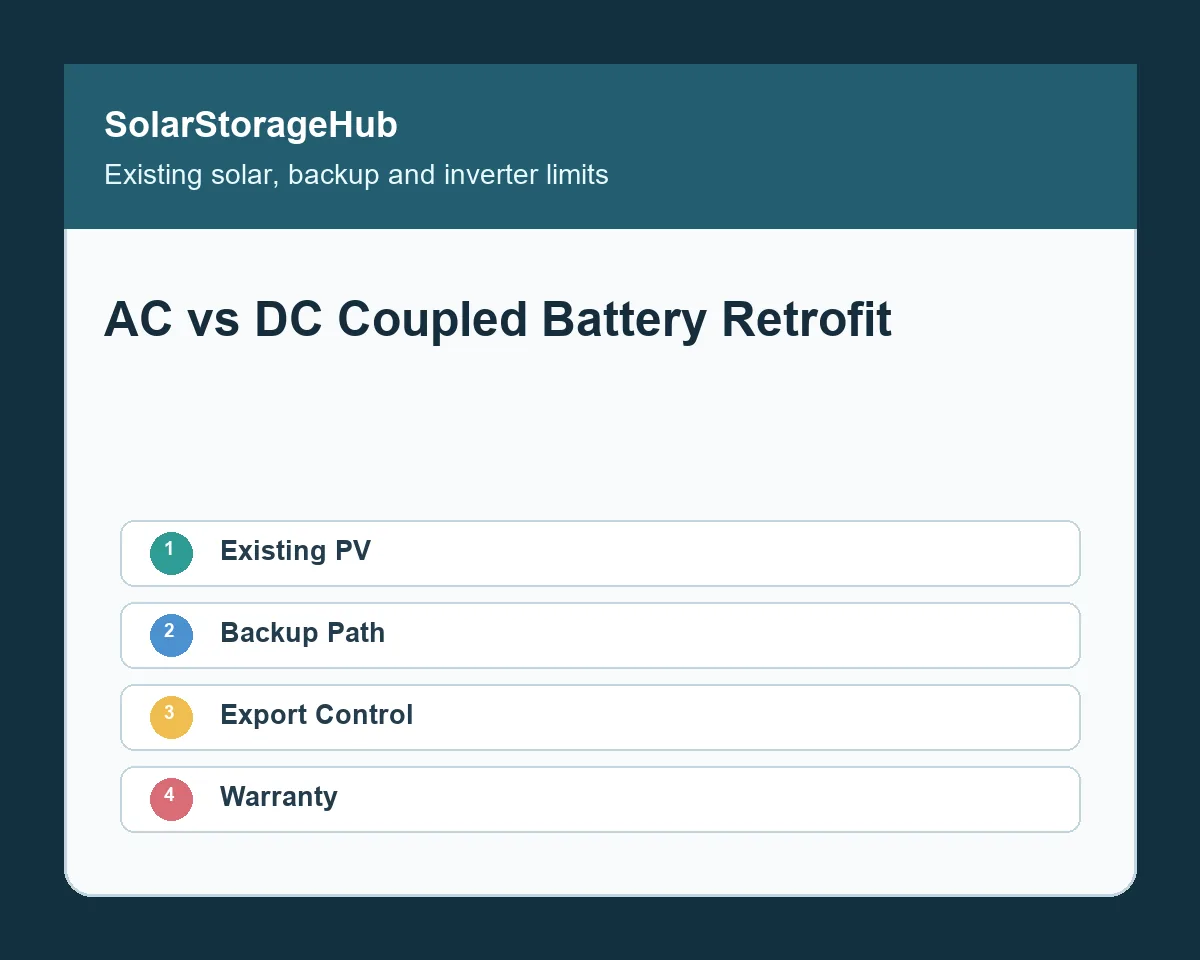
What AC-coupled and DC-coupled mean in a retrofit
In an AC-coupled retrofit, the existing solar inverter continues converting PV power to AC. A separate battery inverter or hybrid battery system charges from the AC side and supplies AC power when required. This can preserve an existing PV system and keep the battery project relatively independent from the original solar inverter.
In a DC-coupled system, PV and battery energy are coordinated on the DC side of a compatible hybrid inverter or power conversion platform. This can reduce the number of conversion steps when solar charges the battery, but a retrofit may require replacing or reconfiguring existing equipment. The labels describe power paths; they do not by themselves prove backup performance, system efficiency or compatibility.
AC-coupled vs DC-coupled retrofit checklist
| Review area | AC-coupled question | DC-coupled question |
|---|---|---|
| Existing PV inverter | Can it remain in service, and can it operate safely with the battery controller? | Will it be replaced, bypassed or integrated into a new hybrid platform? |
| PV array | Does the existing string design remain unchanged? | Do string voltage, current and MPPT limits match the new inverter? |
| Backup operation | Can the PV inverter operate on the backup bus during an outage? | Can the hybrid inverter form the backup supply and restart PV safely? |
| Export control | Which meter or CT controls combined PV and battery export? | Can one controller enforce the site import and export limits? |
| Conversion path | PV-to-battery charging normally includes AC conversion stages. | PV can charge the battery through the shared DC path. |
| Warranty | Are the PV inverter and battery supported by separate parties? | Does replacing equipment affect the original solar warranty? |
| Future expansion | Can battery power or capacity be added without changing the PV array? | Are additional battery and PV inputs supported by the hybrid inverter? |
Inventory the existing solar system first
Before choosing an architecture, record the PV module model, string layout, inverter model, inverter firmware, AC rating, MPPT range, installation date, warranty status, meter arrangement, export limit and main distribution-board rating. Photograph labels and the single-line diagram where available.
An AC-coupled option may look attractive when the existing solar inverter is still reliable and supported. A DC-coupled retrofit may be more practical when the old inverter is near replacement, the array needs reconfiguration, or the buyer wants one coordinated hybrid platform. The decision should include remaining equipment life rather than comparing new hardware alone.
Define backup loads and outage behavior
Ask which circuits must remain powered, which may restart, and which should be excluded. Backup output is limited by inverter power, battery current, surge capability, wiring and protection. A larger battery increases stored energy but does not automatically allow a larger motor or air conditioner to start.
In an AC-coupled system, the existing PV inverter may shut down during an outage unless the battery system creates a suitable backup grid and the PV inverter is approved for that arrangement. In a DC-coupled system, the hybrid inverter typically coordinates PV and battery, but black-start and low-SOC behavior still need verification. Use the Home Battery Backup Transfer Time Checklist to plan the controlled outage test.
Check PV behavior during an outage
Do not assume the solar array will recharge the battery whenever the public grid is unavailable. The system must manage voltage, frequency, battery SOC, PV curtailment and household load while islanded. If battery SOC is high and loads are low, the controller must reduce PV production safely. If SOC is low after a long outage, the system must have a documented restart path.
Ask for a tested description of PV operation on the backup side, including minimum battery conditions, maximum PV power, inverter response and recovery after shutdown. The Solar Panel and Battery Storage Matching guide helps compare array size, recharge time and inverter constraints.
Compare efficiency using the actual energy path
DC coupling can reduce conversion stages when PV directly charges the battery. AC coupling may be efficient when solar power is consumed directly by daytime AC loads, but stored solar energy usually passes through additional conversions. The real annual difference depends on load timing, battery use, inverter efficiency curves, standby consumption and clipping.
Do not select a retrofit from one peak-efficiency number. Request efficiency at realistic power levels and include auxiliary consumption. A slightly less efficient architecture may still be the better project if it avoids replacing a serviceable PV inverter, reduces installation disruption or provides clearer warranty responsibility.
Verify export control and metering
A retrofit can create two independent power sources: the original PV inverter and the battery inverter. Export control must measure and coordinate their combined effect at the point of connection. Incorrect CT direction, meter location or communication can cause unwanted export, import oscillation or poor battery dispatch.
Record the meter or CT model, location, orientation, phase mapping and controller settings. Test export control with PV production, battery charging and battery discharging. The Hybrid Solar Inverter Commissioning Checklist provides a practical commissioning sequence for CT direction, export limits and battery communication.
Review electrical capacity and protection
Adding a battery inverter changes current paths and may affect the main panel, backup panel, breakers, cables, isolation, grounding and fault calculations. The responsible electrical professional should review the existing installation and local requirements. A retrofit should not be approved only because the equipment fits on the wall.
Confirm continuous current, backup current, busbar rating, breaker positions, conductor routes, neutral arrangement and emergency isolation. For outdoor equipment, include enclosure rating, temperature and service clearance. For colder locations, review the LiFePO4 Cold-Weather Charging Checklist.
Clarify warranty and service ownership
AC-coupled systems may leave the original PV warranty intact, but support can involve two inverter suppliers and separate monitoring platforms. DC-coupled retrofits may create one coordinated system but can transfer more responsibility to the new supplier or installer. Buyers should know who diagnoses PV, battery, inverter, meter and communication faults.
Keep the original commissioning records and create a new retrofit file with equipment models, firmware, wiring diagrams, settings, labels, photos and test results. The Home Battery Storage Installation Handover Checklist lists the evidence that should remain with the customer.
Use approved equipment and current documentation
Equipment eligibility, grid requirements and installation rules vary by country and utility. Buyers should check current local listings and approval requirements before ordering. Useful background includes the U.S. Department of Energy solar systems integration basics and the California Energy Commission solar equipment lists.
SolarStorageHub reviews supplied equipment data and project assumptions for quotation support; it does not replace utility approval, electrical design or local inspection. A model listed in one market should not be assumed acceptable in every destination.
What to send for a retrofit review
Prepare the PV module and inverter models, string layout, inverter age, grid type, service rating, export rule, backup circuit list, largest starting load, desired runtime, available installation space, minimum temperature and photos of the meter and distribution board. State whether retaining the existing solar inverter is a priority.
Send the package through Contact. A useful response should identify missing data, likely architecture, inverter and battery limits, and the tests required before handover.
For existing-solar retrofits, the 5kWh floor-mounted solar battery page provides capacity, installation, inverter, and expansion checks. View the product and buyer checks.
Related buyer guide: Retrofit projects should confirm whether new solar input belongs on the DC side or AC side of the battery system. Read 600W Solar Panel Buyer Checklist: Voc, MPPT, Battery Charging and Site Limits.
Related buyer guide: Home battery buyers should compare AC-coupled and DC-coupled retrofit options before choosing equipment. Read Home Energy Storage Batteries Checklist: Capacity, Inverter and Backup.
Related buyer guide: Retrofit projects should confirm whether the floor-mounted battery belongs in an AC-coupled or DC-coupled design. Read 5kWh Floor Mounted Solar Battery: 10kWh and 15kWh Checklist.
FAQ
Is AC coupling always better for an existing solar system?
No. It often preserves existing equipment, but backup behavior, export control, efficiency and support responsibilities still need review.
Is DC coupling always more efficient?
It can reduce conversion stages for solar-to-battery charging, but annual performance depends on the load profile, inverter efficiency and operating strategy.
Can an existing PV inverter work during a grid outage?
Only when the system architecture and approved controls support it. Many grid-tied PV inverters shut down when the public grid fails.
Does adding a battery require replacing solar panels?
Usually not, but a DC-coupled retrofit may require the existing string voltage and current to match the new hybrid inverter.
Can AC-coupled and DC-coupled systems both provide backup?
Yes, when designed for backup. Transfer time, output power, black-start behavior and protected circuits must be verified for the exact system.
What is the biggest retrofit documentation risk?
Missing inverter, string, meter and distribution-board information can lead to an incorrect quotation or an unsupported installation plan.
What should be tested before handover?
Test metering, export control, battery communication, grid loss, backup loads, PV behavior during outage, grid return and low-SOC recovery.
Related SolarStorageHub Resources
If you are turning this article into a buying decision, compare the relevant product families and send your inverter model, target capacity, installation country, and quantity plan for confirmation.