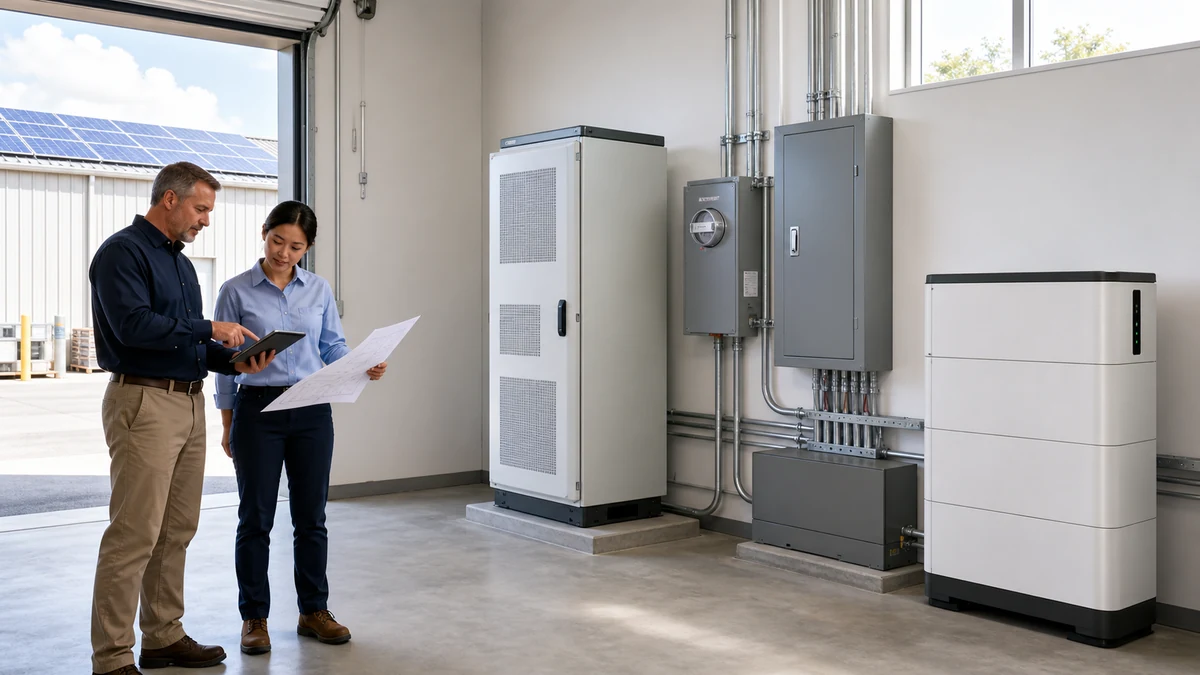

Home Battery Backup Transfer Time Checklist: EPS Output, Critical Loads and Restart Testing
Commissioning note: A home battery can have enough energy on paper and still disappoint during an outage. The usual causes are not battery capacity alone. They are transfer delay, an overloaded backup output, motor starting current, an incomplete critical-load list, or a restart sequence that was never tested with the grid disconnected.
This guide is for distributors, installers and project buyers comparing Home Energy Storage, Solar Inverter, Solar Panel, and smaller C&I ESS systems. Use it with the Battery Storage Buyer Resources hub, then send the actual load list and inverter model through Contact before confirming a backup design.
Why transfer performance belongs in the battery quotation
Many quotations show battery kWh, inverter kW and an estimated runtime. Those numbers matter, but they do not describe what happens in the first seconds after the grid fails. A customer may expect lights, internet equipment, a refrigerator and a circulation pump to continue without interruption. The system may instead pause, shed a load, or restart equipment after the inverter changes operating mode.
The correct expectation depends on the inverter architecture, backup or EPS output, wiring arrangement, local electrical rules and the behavior of each connected appliance. A transfer time that is acceptable for lighting may still restart a desktop computer, network switch or sensitive controller. Buyers should therefore ask for a tested operating description, not a vague claim that the system provides backup.
Home battery backup transfer time checklist
| Check area | What to confirm | Evidence to save |
|---|---|---|
| Backup architecture | Whole-home backup, selected-load panel, or dedicated EPS outlet; single-phase or three-phase arrangement. | Single-line diagram and photos of the distribution board. |
| Transfer behavior | Published transfer range and measured interruption with the actual firmware and operating mode. | Commissioning video, event time and inverter log. |
| Continuous output | Backup output rating at the expected temperature and battery SOC. | Inverter datasheet and final settings record. |
| Starting surge | Motor, compressor, pump and transformer inrush compared with inverter surge capability. | Load nameplate photos and start-test result. |
| Critical loads | Equipment that must remain powered, equipment allowed to restart, and equipment excluded from backup. | Approved circuit schedule with measured watts. |
| Restart sequence | Delay between large loads so they do not all start when backup power appears. | Control settings and outage test notes. |
| Low-SOC behavior | Reserve SOC, shutdown threshold, grid-return behavior and black-start limitation. | Screenshots of battery and inverter settings. |
Define the backup circuit before selecting capacity
Start with the circuits, not the battery model. Walk through the site and separate loads into three groups: must remain available, may be restored after a short delay, and should never be connected to the backup output. The first group may include lighting, internet equipment, security, refrigeration, medical equipment or a small water pump. Electric water heating, large air conditioning, cooking appliances and vehicle charging often need separate review.
Record both operating watts and starting behavior. A refrigerator may use modest energy over a day but demand a much higher current for a short period when its compressor starts. The Home Battery Storage Backup Load List explains how to build the circuit list, while How to Estimate Battery Storage Runtime covers usable kWh and solar recharge.
Separate transfer time from runtime
Transfer time and runtime answer different questions. Transfer time describes how long the load loses power while the system changes from grid-connected operation to backup operation. Runtime describes how long the battery can support the loads after that transfer. A large battery can extend runtime, but it does not automatically reduce transfer delay.
Ask the inverter supplier how transfer time is specified and under which mode. Some systems have a dedicated backup output with different limits from the normal grid-connected output. Some loads will tolerate the interruption; others will reboot. If uninterrupted operation is essential, the buyer should verify whether the specific equipment needs its own UPS rather than assuming the home battery behaves like one.
Test motor and compressor starting current
Starting current is one of the most common reasons a backup test fails. Pumps, refrigerators, freezers and air conditioners can draw several times their normal running current at startup. Two devices that start together may exceed the inverter surge limit even though their combined running power looks acceptable.
Use measured data where possible. If only nameplate information is available, keep a conservative margin and test the exact equipment during commissioning. A delayed restart relay, soft starter or revised circuit priority may solve the problem, but those changes should be designed by the responsible installer. Do not increase protection settings simply to force a test to pass.
Confirm battery, BMS and inverter limits together
The inverter rating is only one limit. Battery discharge current, BMS protection, cable size, breaker rating, temperature and SOC can all reduce the available backup power. A system with several batteries in parallel also needs approved BMS addressing and current sharing. Review the LiFePO4 Battery Parallel Connection Checklist before treating added battery modules as extra power.
Communication should also be tested. Incorrect CAN or RS485 settings can produce a wrong SOC value or cause the inverter to use a fallback voltage mode. The Solar Inverter and Battery Matching Mistakes guide lists the settings and records buyers should request before shipment.
Run a controlled outage test
A commissioning test should reproduce the customer expectation under controlled conditions. First confirm that wiring, labels, protection and grounding have been inspected by the responsible electrical professional. Record grid status, battery SOC, PV condition, active loads and inverter mode. Then isolate the grid using the approved procedure and observe which loads remain powered, which restart and which are shed.
Repeat the test with at least one realistic high-demand condition. Watch for inverter alarms, BMS events, dimming, repeated compressor starts and unexpected neutral or phase issues. Restore the grid and confirm the return sequence. The test record should include time, load list, SOC before and after, screenshots, photos, alarm history and the name of the person who performed the test.
The Home Battery Storage Installation Handover Checklist provides a broader handover record. For safety documentation background, buyers can also review UL Solutions energy storage system testing and certification and the U.S. Department of Energy energy storage resources.
Set expectations for low SOC and long outages
A successful transfer at 90% SOC does not describe every outage. Buyers should understand what the system does near reserve SOC, after the battery reaches its shutdown limit, and when solar is unavailable. Ask whether the inverter can restart from PV after a full shutdown, what minimum battery voltage is required, and whether manual intervention may be needed.
Reserve SOC is a tradeoff. A higher reserve provides more emergency energy but reduces the capacity available for daily self-consumption. The setting should reflect the customer's outage risk and critical loads. Record the agreed setting during handover so a later app change does not create a warranty or support dispute.
What distributors should request before approving a model
For each inverter-battery combination, keep a short compatibility file: inverter model and firmware, battery model and firmware, communication protocol, maximum battery quantity, continuous and surge limits, approved operating mode, transfer-time description, test load, alarm screenshots and known exclusions. This file is more useful to a sales and support team than a general compatibility logo.
SolarStorageHub reviews project assumptions using the supplied datasheets, load list, photos and commissioning records; it does not replace local electrical design or inspection. Send the country, grid type, critical-load schedule, largest starting load, desired runtime, inverter model and battery quantity through Contact for a practical pre-quotation review.
Related buyer guide: The inverter commissioning file should include the controlled EPS transfer and critical-load restart test described in this guide. Read Hybrid Solar Inverter Commissioning Checklist: CT Direction, Export Limit and Battery Protocol.
Related buyer guide: Cold-weather backup testing should cover transfer behavior, reserve SOC and automatic restart after the battery warms. Read LiFePO4 Cold-Weather Charging Checklist: BMS Cut-Off, Battery Heating and Winter Testing.
Related buyer guide: AC and DC coupled retrofit designs should both be verified with a controlled backup transfer and restart test. Read AC-Coupled vs DC-Coupled Home Battery Retrofit: Solar, Backup and Inverter Checklist.
Related buyer guide: Solar recharge is useful only when the backup system can also transfer and restart the required critical loads. Read 600W Solar Panel Buyer Checklist: Voc, MPPT, Battery Charging and Site Limits.
Related buyer guide: Backup behavior should be tested with real critical loads, not only assumed from battery capacity. Read Home Energy Storage Batteries Checklist: Capacity, Inverter and Backup.
Related buyer guide: Runtime estimates should be checked with real backup transfer and restart behavior. Read 5kWh Floor Mounted Solar Battery: 10kWh and 15kWh Checklist.
Related buyer guide: Backup transfer and load restart behavior should be tested after inverter setup. Read Solar Battery Storage Inverter Checklist: Voltage, PV Input and Backup.
Related buyer guide: Backup output should be reviewed with critical loads and restart behavior. Read 5kWh Modular Portable Power Station Checklist: Output and Solar Recharge.
FAQ
What is home battery backup transfer time?
It is the interruption between loss of grid power and the backup output supplying the selected loads. The actual result depends on inverter mode, wiring, firmware and connected equipment.
Will every appliance stay on during the transfer?
No. Lights may appear unaffected while computers, routers or controllers restart. Sensitive equipment may still require a dedicated UPS.
Does a larger battery reduce transfer time?
Usually not. More battery capacity can extend runtime, but transfer behavior is primarily determined by the inverter and backup architecture.
Why can a refrigerator trip the backup output?
The compressor starting current can be much higher than its running power. Several starting loads at the same time can exceed the inverter surge limit.
Should the entire home be connected to backup power?
Only when the system, distribution board and operating plan are designed for whole-home backup. A selected critical-load panel is often easier to control and verify.
What should be recorded during an outage test?
Record battery SOC, active loads, inverter mode, transfer behavior, alarms, restart sequence, screenshots, photos and the grid return result.
What information is needed for a backup system review?
Provide the load schedule, largest motor or compressor, desired runtime, inverter model, battery model and quantity, grid type, country and distribution-board photos.
Related SolarStorageHub Resources
If you are turning this article into a buying decision, compare the relevant product families and send your inverter model, target capacity, installation country, and quantity plan for confirmation.