
LiFePO4 Battery Parallel Connection Checklist: BMS Address, Current Sharing and Inverter Limits
Installer note: Parallel LiFePO4 battery connection should be treated as a system design decision, not a shortcut for adding more kWh. Buyers and installers need to check BMS limits, inverter current, cable length, breaker sizing, address settings, SOC balance, firmware, installation records and future expansion rules before connecting multiple batteries together.
This checklist is written for distributors, installers and EPC teams working with Home Energy Storage, smaller C&I ESS, Solar Inverter, and Solar Panel systems. Use it with the Battery Storage Buyer Resources hub, and send project details through Contact when a battery-to-inverter match needs review.
Why parallel connection deserves a checklist
Adding a second or third battery can look simple because each unit has the same nominal voltage. In practice, parallel operation depends on current sharing, BMS communication, cable resistance, inverter settings and state-of-charge balance. A weak parallel design may work during a light test and fail when the customer adds a larger load or expects longer backup time.
For distributors, the risk becomes larger when the same battery is sold into different inverter ecosystems. One inverter may read the master battery correctly, while another needs a different protocol, address setting or voltage-based fallback. A written checklist helps avoid support calls that could have been prevented before shipment.
Parallel battery connection checklist
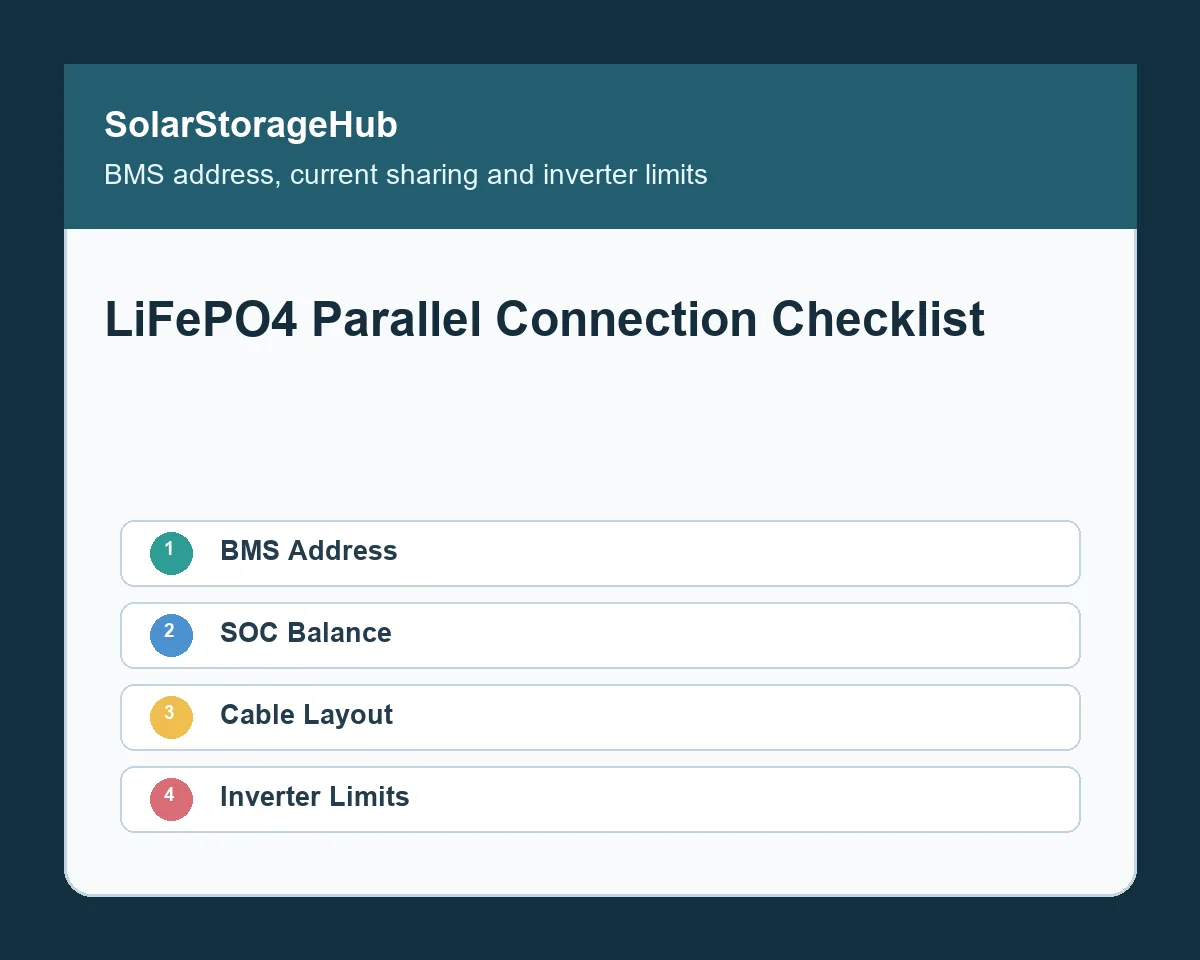
| Check area | What to confirm | Why it matters |
|---|---|---|
| Maximum units | Supplier-approved number of batteries in parallel and whether all units must use the same model and firmware. | Prevents unsupported expansion and warranty disputes. |
| BMS address | Master/slave setting, DIP switch, software address, communication cable order and inverter profile. | Allows the inverter to read the correct battery data. |
| SOC balance | Similar SOC and voltage before connection, plus rest time if the supplier recommends it. | Reduces equalization current and early alarms. |
| Cable layout | Equal cable length, correct cable size, clean terminals, torque and protected routing. | Improves current sharing and reduces heating risk. |
| Protection | Breaker, fuse, disconnect, grounding, label and emergency access requirements. | Supports safer service and clearer troubleshooting. |
| Inverter limits | Charge current, discharge current, battery mode, voltage limits and communication protocol. | Keeps the inverter within the battery system limit. |
| Records | Serial numbers, photos, settings screenshots, BMS logs and commissioning notes. | Creates evidence for service and warranty review. |
Start with supplier-approved limits
The first question is how many units the supplier supports in parallel. Do not assume unlimited expansion. The limit may depend on BMS design, communication method, cable kit, inverter current, battery firmware and installation environment. Ask whether the units must be the same capacity, same batch, same firmware and same model.
For distributors, this limit should be written into the quotation and installation guide. If a customer may expand later, the first installation should leave enough space, cable route, breaker capacity and inverter headroom. The Home Battery Storage Installation Handover Checklist is useful for recording those assumptions at the first installation.
Match BMS communication with the inverter
Parallel batteries often use one master battery to communicate with the inverter. If the address setting, cable order or protocol is wrong, the inverter may show wrong SOC, report alarms or fail to charge correctly. Installers should record the master battery, slave order, communication cable, inverter battery profile and any software setting used during commissioning.
Use Solar Inverter and Battery Matching Mistakes and BMS Parameters Buyers Should Check before approving a new inverter-battery combination. For sample testing, the LiFePO4 Battery Sample Order Checklist helps buyers verify the exact setup before batch purchase.
Balance batteries before connection
Before connecting batteries in parallel, check voltage and SOC. If one unit is much higher or lower than another, equalization current may appear when the batteries are connected. Follow the supplier manual for acceptable voltage difference, rest time and charging procedure. Do not mix old and new batteries without checking the supplier's expansion rules.
For installers, the practical record is simple: photograph the battery labels, write down SOC or voltage for each unit, record the connection order and save a screenshot after the inverter recognizes the system. This evidence is useful if a battery later reports imbalance, communication loss or unexpected shutdown.
Check inverter current and load behavior
Adding parallel batteries may increase available energy, but the inverter still controls how much power can be delivered to the load. If the inverter is undersized, adding more batteries will not allow large motors, compressors or air conditioners to start safely. If the BMS current limit is lower than the inverter setting, the system may trip during high demand.
For runtime expectations, review How to Estimate Battery Storage Runtime. For voltage platform decisions, compare 48V vs High-Voltage Solar Batteries. External references such as UL Solutions energy storage system testing and certification and IEC 62619:2022 are useful background when buyers review safety claims and battery documentation.
Document the installation for warranty review
Parallel systems need clean records. Keep serial numbers, wiring photos, breaker ratings, cable length notes, inverter settings, BMS logs, communication address settings, firmware information and final SOC screenshots. If a warranty question appears later, these records help the supplier separate installation issues from product issues.
The guide LiFePO4 Battery Warranty Claim Evidence gives a structured record list. SolarStorageHub recommends making this record part of every first installation and every expansion project.
What to send SolarStorageHub for review
For a parallel battery review, prepare battery model, quantity, inverter model, battery firmware if available, communication method, target load, expected backup time, installation photos and country. Send the information through Contact so the system can be checked before shipment or expansion.
Related approval and document checks
These related guides help buyers connect product testing, documentation, certification and after-sales evidence before approving a larger order.
- sample approval checklist before batch purchase
- battery certification document control
- OEM documentation approval workflow
FAQ
Can any LiFePO4 batteries be connected in parallel?
No. Parallel connection should follow the supplier's approved model, firmware, quantity, communication and cable rules.
Should batteries have similar SOC before parallel connection?
Yes. Batteries should be close in voltage and SOC according to the supplier's manual before they are connected together.
Does parallel connection increase inverter power?
No. It increases available battery capacity and sometimes available current, but the inverter power rating still limits the AC output.
Why does address setting matter?
Address setting tells the BMS and inverter which unit is master and how the other batteries should communicate. Wrong settings can cause communication faults.
Can old and new batteries be mixed?
Only if the supplier allows it. Age, firmware, capacity, internal resistance and warranty terms should be checked before mixing units.
What records should installers save?
Save serial numbers, wiring photos, cable details, breaker ratings, SOC readings, inverter settings, BMS logs and communication address settings.
Where should parallel connection questions be sent?
Send battery model, quantity, inverter model, load target, installation photos and communication details through the Contact page.
Related SolarStorageHub Resources
If you are turning this article into a buying decision, compare the relevant product families and send your inverter model, target capacity, installation country, and quantity plan for confirmation.