
OEM LiFePO4 Battery Documentation Checklist for Private-Label Buyers
Procurement note: OEM and private-label LiFePO4 battery projects need more than a logo file. Buyers should confirm label wording, manual language, certificate scope, warranty terms, carton artwork, serial number rules, shipping documents and after-sales evidence before approving a batch order. A weak document package can slow customs, confuse installers and create warranty disputes.
This checklist is written for distributors and OEM/ODM buyers comparing Home Energy Storage, C&I ESS, Solar Inverter, and Solar Panel product paths. Use it with the Battery Storage Buyer Resources hub, and send OEM documentation questions through Contact.
Why OEM documentation affects more than marketing
Private-label documentation is often treated as a design task, but it is also a technical and compliance task. The model name on the label should match the datasheet, manual, certificate, carton, packing list and warranty terms. If those names drift apart, the buyer may face confusion during sales, customs clearance, installation or after-sales review.
A strong OEM file helps everyone use the same product identity. Sales teams know what they are quoting. Installers know which manual to follow. Logistics teams know which shipping documents belong to the order. Support teams can connect serial numbers, photos, BMS logs and warranty records to the correct model.
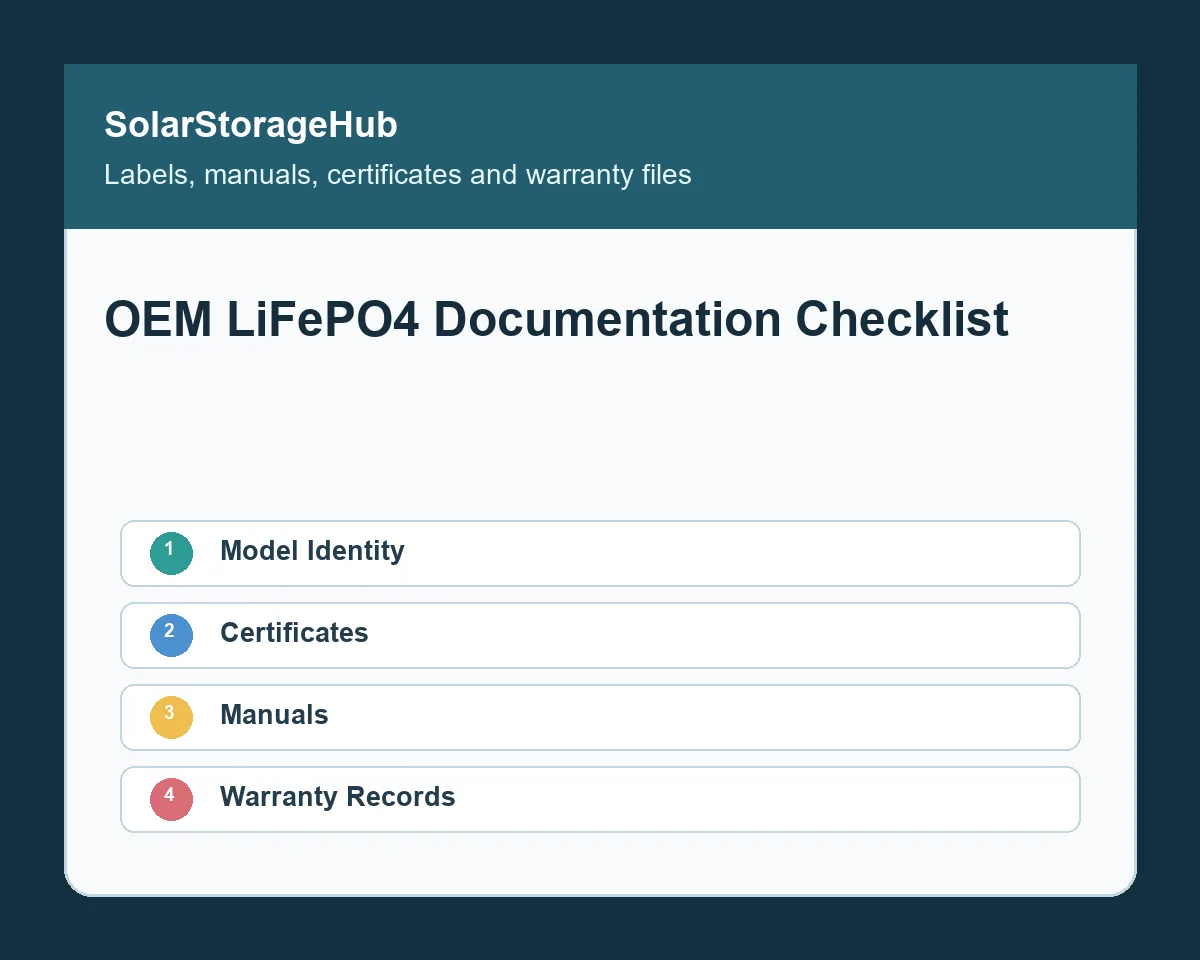
OEM LiFePO4 battery documentation checklist
| Document area | What to check | Why it matters |
|---|---|---|
| Model identity | Product name, voltage, capacity, chemistry, model code, serial number rule and label language. | Prevents confusion across datasheet, carton, certificate and warranty file. |
| Datasheet | Nominal voltage, usable energy, current limits, communication protocol, dimensions, weight and operating temperature. | Supports sales, quotation, inverter matching and installation planning. |
| Manual | Installation steps, wiring, parallel rules, inverter settings, alarms, maintenance and safety notes. | Reduces installer mistakes and support calls. |
| Certificate package | Certificate scope, test report model, issuing body, report date and whether private label affects scope. | Protects procurement, customs, project approval and buyer claims. |
| Warranty terms | Cycle life, DoD, retention, exclusions, claim evidence and service process. | Makes after-sales responsibility clearer before shipment. |
| Packaging | Carton artwork, label, pallet photo, warning marks, packing list and accessory list. | Reduces export mistakes and customer complaints. |
| Support evidence | Commissioning record, BMS log, inverter setting, installation photos and serial numbers. | Helps suppliers review problems with evidence. |
Start with one approved model identity
The first OEM decision should be the model identity. Buyers should define the brand name, model code, voltage, capacity, chemistry, enclosure type and serial number rule. This identity should appear consistently on the label, datasheet, manual, carton, packing list and warranty document.
For private-label home battery programs, compare the product path with Choosing an OEM LiFePO4 Battery Supplier. For larger commercial projects, connect the model identity with the site and quote workflow in C&I ESS Quote Checklist.
Check certificate scope before changing labels
Certificate scope should be reviewed before the buyer changes model naming, branding or labels. Some private-label changes may be simple artwork. Others may require confirmation from the supplier or test body, especially if the model number, ratings or configuration changes. Buyers should ask whether the certificate package can be used with the private-label name and what supporting documents are needed.
The Battery Certification Documents guide explains how to compare model names, certificate scope and reports. External references such as IEC 62619:2022 and UL Solutions energy storage system testing and certification are useful background when buyers review safety claims.
Make the manual useful for installers
An OEM manual should not be a generic brochure. It should tell installers how to mount or place the battery, how to connect cables, how to set communication, how to add batteries in parallel if allowed, how to read alarms, what clearance is needed and what evidence to save during handover. If the product is sold with a common inverter list, the manual or settings sheet should explain the tested profiles.
For inverter-related documentation, use Solar Inverter and Battery Matching Mistakes and LiFePO4 Battery Parallel Connection Checklist. These pages help buyers turn support questions into manual content before the batch ships.
Connect documents with the sample order
The sample stage is where the buyer should test the document package. The delivered sample should match the datasheet, label, manual, certificate scope, carton, accessory list and warranty terms. If the sample uses temporary labels or incomplete manuals, write down what must be corrected before mass production.
Use LiFePO4 Battery Sample Order Checklist before approving a batch purchase. The sample order should produce a short approval file: photos, settings screenshots, BMS logs, packaging photos, document list and open correction items.
Prepare shipping and warranty files together
Shipping documents and warranty documents should not be separated from OEM work. Carton labels, packing lists, serial numbers and accessory lists help logistics teams, but they also help after-sales teams later. If a battery arrives damaged or a customer reports missing accessories, the shipment photo and serial number record become part of the support file.
Use LiFePO4 Battery Shipping Documents and Packaging Checklist and LiFePO4 Battery Warranty Claim Evidence to define the records buyers should keep before export and after installation.
What to send SolarStorageHub for OEM review
For OEM documentation review, prepare target market, product type, voltage and capacity, branding requirements, label language, manual language, carton artwork, certificate expectations, warranty wording, shipping destination and first order quantity. If an inverter brand is already selected, include the model and communication requirement.
Send the details through Contact. SolarStorageHub can help buyers connect product identity, documentation, sample approval, shipping evidence and after-sales support before a private-label battery program scales.
Private-label approval workflow
OEM buyers should approve documents in a fixed order so branding does not break technical consistency. Start with model identity, then approve datasheet, label, certificate scope, manual, warranty wording, carton artwork and shipping documents. Final approval should happen after the sample confirms the document set.
| Step | Decision | Output |
|---|---|---|
| 1 | Approve brand, model code, voltage, capacity and serial number rule. | Model identity sheet |
| 2 | Check certificate scope against the private-label model. | Certificate review note |
| 3 | Review manual, labels, carton and accessory list. | Approved document package |
| 4 | Test one sample against inverter, BMS, packaging and documents. | Sample approval record |
| 5 | Freeze files before batch production and shipment. | Batch release file |
This workflow should link back to the LiFePO4 Battery Sample Order Checklist and Battery Certification Documents. It gives procurement, sales, logistics and after-sales teams one shared record before the private-label program scales.
Related buyer guide: Private-label documentation should connect approved model identity and artwork with the serial and shipment evidence in this module checklist. Read Solar Panel Pre-Shipment Inspection Checklist: EL Test, Flash Data and Container Loading.
FAQ
What documents are needed for an OEM LiFePO4 battery order?
Buyers usually need datasheet, manual, label file, carton artwork, warranty terms, certificate package, packing list, shipping documents and support evidence requirements.
Can private-label branding affect certificate scope?
It can. Buyers should ask whether the certificate package supports the private-label model name and whether extra confirmation is needed from the supplier or test body.
What should be checked on the product label?
Check brand, model, voltage, capacity, chemistry, warning text, serial number rule, QR code if used and whether the label matches the datasheet and carton.
Why should the sample order include document review?
The sample stage confirms whether the real product, labels, manual, carton, certificate package and warranty terms are consistent before batch production.
What should be included in an installer manual?
The manual should include mounting, wiring, communication settings, inverter notes, alarm meanings, parallel rules, maintenance and safety instructions.
How can OEM buyers reduce after-sales disputes?
Keep clear serial number records, installation photos, BMS logs, inverter settings, warranty terms, shipping photos and customer handover records.
Where should OEM documentation questions be sent?
Send product type, target market, label needs, certificate expectations, manual language, carton artwork and order plan through the Contact page.
Related SolarStorageHub Resources
If you are turning this article into a buying decision, compare the relevant product families and send your inverter model, target capacity, installation country, and quantity plan for confirmation.