
Solar Inverter and Battery Matching Mistakes: CAN/RS485, Voltage Window and BMS Limits
Buyer note: A solar inverter and a LiFePO4 battery can both look correct on paper and still fail during commissioning. Most matching problems are not caused by chemistry alone. They come from voltage window, CAN or RS485 protocol, BMS current limits, firmware, SOC reporting, cable pinout, charge settings, and missing commissioning evidence.
This guide is written for distributors, installers, EPC teams and OEM buyers comparing energy storage inverter range, Home Energy Storage, C&I ESS, and Solar Panel product paths. Use it with the Battery Storage Buyer Resources hub, and send project details through Contact when you need battery-to-inverter matching review.
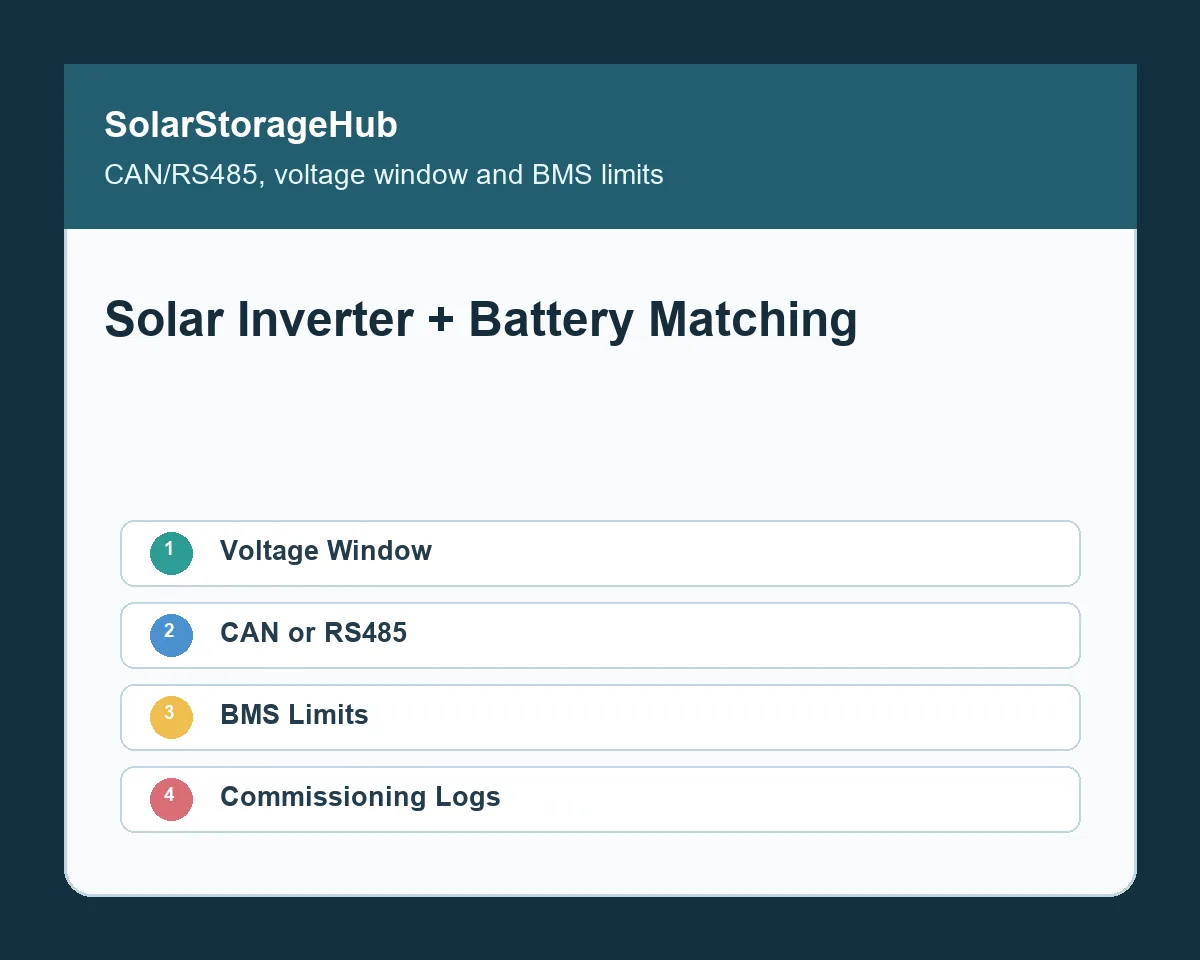
Mistake 1: assuming voltage is the whole compatibility check
Voltage range is only the first gate. A 51.2V LiFePO4 battery may match the general DC voltage range of a hybrid inverter, but that does not guarantee stable operation. The buyer still needs to check charge voltage, discharge cut-off, maximum charge current, maximum discharge current, BMS protection values and inverter battery mode.
For high-voltage batteries, the stack configuration must also match the inverter voltage window. Minimum and maximum module count matter. If the stack is too small, the inverter may not start. If the stack is too high, the system may exceed the safe operating range. A quote should define the exact inverter model, battery model and approved stack range.
Mistake 2: treating CAN and RS485 as generic labels
CAN and RS485 describe communication methods, not a universal language. A battery and inverter may both mention CAN, but the data map, cable pinout, baud rate, protocol profile, address setting and firmware may still differ. The inverter may show SOC incorrectly, stop charging too early, report alarms, or fail to recognize the battery.
The older guide CAN vs RS485 Solar Battery Compatibility explains the protocol difference. For a more current buyer workflow, also read LiFePO4 Battery Inverter Compatibility. Buyers should ask for test evidence, not only a brand list.
Compatibility checklist
| Check item | What to confirm | Common failure if skipped |
|---|---|---|
| Voltage window | Battery nominal voltage, operating range, charge voltage and inverter accepted DC range. | Inverter does not start, stops charging, or triggers protection. |
| Communication | CAN or RS485 profile, cable pinout, address setting, baud rate and inverter battery mode. | Wrong SOC, missing battery data, alarm messages or unstable operation. |
| Current limits | BMS charge current, discharge current, inverter power, surge load and parallel battery limits. | Overload, BMS shutdown, slow charging or poor backup performance. |
| Firmware | Inverter firmware, battery firmware and whether the tested version matches the buyer's unit. | Compatibility works in one batch but fails in another. |
| Settings | Battery type, charge voltage, float voltage, low-voltage cut-off and communication mode. | Battery cycles poorly or warranty limits are exceeded. |
| Evidence | Photos, screenshots, BMS logs, inverter display, alarm history and commissioning record. | After-sales review becomes slow and unclear. |
Mistake 3: ignoring BMS current limits
Battery capacity in kWh does not tell the buyer how much power the battery can safely deliver at one time. The BMS current limit is often the hidden constraint. If the inverter demands more current than the battery can provide, the system may trip, reduce output, or fail when a motor starts.
Buyers should compare inverter continuous power, surge rating, battery voltage and BMS discharge current. They should also check charge current. A battery that is safe for slow charging may not accept the full PV or grid charge current the inverter can deliver. The article BMS Parameters Buyers Should Check gives more detail on this review.
Mistake 4: testing with a different inverter model
Brand-level compatibility is not enough. A battery may work with one inverter model from a brand and still need different settings on another model. Firmware version can also change behavior. For distributors, a sample order should be tested with the same inverter model that the customer plans to install.
During a sample order, record the inverter model, firmware version, battery mode, cable type, communication setting, charge current, discharge current, SOC display and any alarms. The LiFePO4 Battery Sample Order Checklist explains how to turn this test into a buyer-level approval process before batch purchase.
Mistake 5: forgetting solar panel and load behavior
Battery and inverter matching should also consider solar panel input and load behavior. A system may charge slowly if PV capacity is too small or site shading is heavy. It may overload if the buyer connects pumps, compressors, air conditioning or other surge loads without checking inverter power. Battery matching is part of a system, not a standalone product decision.
For PV output estimates, tools such as NREL PVWatts can support early discussion. For safety and certification context, UL Solutions energy storage system testing and certification and IEC 62619:2022 are useful references when buyers review battery documentation and system claims.
Mistake 6: not keeping commissioning evidence
When a system fails after installation, the supplier needs evidence. Without serial numbers, photos, inverter settings, BMS logs, alarm screenshots and wiring details, the support team has to guess. This slows down troubleshooting and can create warranty disputes.
Good installers keep a small commissioning file for every project. It should include product labels, wiring photos, breaker ratings, inverter settings, communication cable details, battery SOC, cell voltage where available, alarm history and handover notes. The guide LiFePO4 Battery Warranty Claim Evidence gives a clear record list for after-sales review.
How to write a better inverter matching request
A useful matching request should include the inverter brand and exact model, firmware version if known, battery voltage target, required kWh, backup loads, surge loads, PV size, country, installation type, communication preference, and whether the buyer needs OEM or private-label documents. If the buyer has already installed similar systems, include photos and settings from the working site.
For larger commercial systems, also include grid voltage, phase, PCS requirement, transformer condition, site survey notes and C&I ESS cabinet expectations. For smaller residential systems, include whether the buyer needs wall-mounted, rack-mounted, stacked or floor-mounted battery products.
What SolarStorageHub can review
SolarStorageHub can help buyers compare inverter communication requirements, LiFePO4 battery voltage platform, BMS limits, sample order checks, documents and after-sales evidence. The review is strongest when the buyer shares real inverter model data and load information instead of only asking for a battery price.
Before sending an inquiry, collect the inverter model, target capacity, application, installation country, PV size, load list, document needs and order plan. Then send it through Contact for product matching support.
Related buyer guide: For inverter matching, this guide shows how solar panel input and charge current affect the full system design. Read Solar Panel and Battery Storage Matching: PV Recharge, Inverter Limits and Buyer Checks.
Related buyer guide: Correct CAN or RS485 settings support reliable SOC reporting during backup transfer and low-SOC operation. Read Home Battery Backup Transfer Time Checklist: EPS Output, Critical Loads and Restart Testing.
Related buyer guide: After matching voltage and communication, use this commissioning checklist to verify the installed CT, export control and operating modes. Read Hybrid Solar Inverter Commissioning Checklist: CT Direction, Export Limit and Battery Protocol.
Related buyer guide: Common inverter and battery matching mistakes should be reviewed before ordering a storage inverter. Read Solar Battery Storage Inverter Checklist: Voltage, PV Input and Backup.
Related buyer guide: Inverter and BMS communication limits must be checked before ordering a floor mounted battery. Read Floor Mounted Battery Checklist: Space, Wiring and Inverter Fit.
Related buyer guide: Inverter and BMS compatibility should be checked before shipping a 30kWh LiFePO4 battery. Read 30kWh LiFePO4 Battery Checklist: 600Ah, Runtime and Inverter Fit.
Related buyer guide: CAN, RS485, voltage window and BMS limits are common inverter matching risks. Read Power Storage Inverter Checklist: Grid Mode, Battery Protocol and Export.
Related buyer guide: CAN, RS485, voltage window and BMS limits are common inverter matching risks. Read Floor Mounted Energy Storage System Checklist: 5kWh, Wiring and Setup.
Related buyer guide: CAN, RS485, voltage and BMS settings are common inverter matching failure points. Read 18kW Three Phase Solar Inverter Checklist: Battery Protocol and PV Input.
FAQ
Can any LiFePO4 battery work with any hybrid inverter?
No. The voltage range, communication protocol, BMS current limits, firmware, cable pinout and inverter settings must be checked before installation.
Is CAN better than RS485 for inverter communication?
Neither is automatically better. The right choice depends on what the inverter supports and whether the battery profile has been tested with that exact model.
What causes wrong SOC readings?
Wrong SOC can come from incompatible protocol, wrong battery mode, cable pinout issues, firmware mismatch, address settings or poor calibration between battery and inverter.
Why does a battery trip when loads start?
The inverter surge load or continuous power demand may exceed the BMS discharge current limit, or the inverter may be undersized for motors and compressors.
Should buyers test a sample before batch orders?
Yes. A sample test with the exact inverter model is one of the best ways to confirm communication, settings, accessories, documentation and support quality.
What evidence should installers save?
Save product labels, serial numbers, wiring photos, inverter settings, BMS logs, alarm screenshots, communication cable details and commissioning notes.
Where should inverter matching questions be sent?
Send the inverter model, battery target, PV size, load profile, country, communication needs and document requirements through the Contact page.
Related SolarStorageHub Resources
If you are turning this article into a buying decision, compare the relevant product families and send your inverter model, target capacity, installation country, and quantity plan for confirmation.