
Solar Battery Storage Inverter Checklist: Voltage, PV Input and Backup
Buyer note: A solar battery storage inverter should be selected around the complete system: battery voltage, BMS protocol, PV input, backup output, export-control rules, monitoring, installation country and the loads that must keep running during an outage. A powerful inverter is not useful if it cannot communicate with the battery or if the PV input cannot recharge the system as expected.
This checklist is written for installers, distributors, EPC buyers and homeowners comparing Solar Inverter, Home Energy Storage, Solar Panel, and small C&I ESS configurations. Use it with the Battery Storage Buyer Resources hub, or send project details through Contact before choosing an inverter model.
Start with the battery platform
The first inverter check is battery voltage. A low-voltage inverter may support 48V or 51.2V LiFePO4 batteries, while a high-voltage hybrid inverter may require a different battery stack, voltage range and protection method. The battery voltage must match the inverter input range under charge, discharge, low SOC, full SOC and temperature changes.
Communication is just as important as voltage. If the inverter and battery communicate by CAN, RS485 or a brand-specific protocol, the buyer should request the supported battery list, cable pinout, firmware requirement and recommended settings. The Solar Inverter Battery Matching Mistakes guide explains why many field problems come from communication and parameter mismatch rather than from the battery cells themselves.
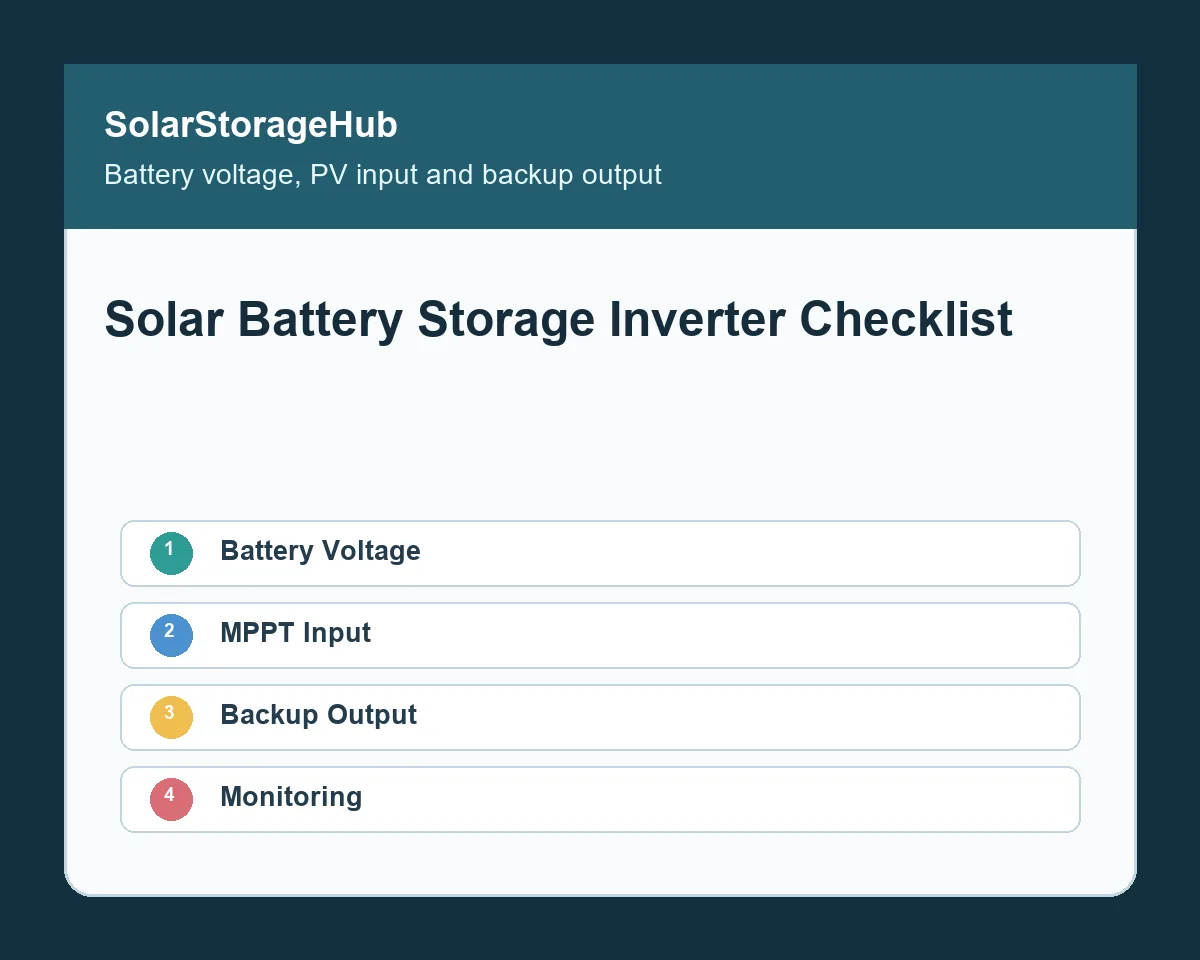
Solar battery storage inverter checklist
| Check area | What to confirm | Why it matters |
|---|---|---|
| Battery voltage | Low-voltage or high-voltage platform, operating range and BMS limits. | Prevents an inverter from being paired with the wrong battery architecture. |
| BMS protocol | CAN, RS485, supported brand list, firmware and parameter file. | Controls SOC display, alarms, current limits and protection behavior. |
| PV input | MPPT voltage range, max PV voltage, current, string layout and cold-weather Voc. | Protects the inverter and defines realistic battery recharge. |
| Backup output | EPS or backup power, transfer time, surge rating and critical-load panel. | Determines whether loads restart safely during an outage. |
| Export control | CT direction, meter location, zero-export mode and grid rules. | A wrong CT or meter location can break self-consumption and compliance. |
| Monitoring | Local display, app, data export, alarms and user roles. | Helps the installer diagnose issues and the owner understand operation. |
| Installation scope | Breaker, cable, surge protection, labeling, commissioning and handover records. | Turns a datasheet selection into a working system. |
Check PV input before finalizing the inverter
PV input is often overlooked when buyers focus on battery capacity. The inverter should support the planned string voltage and current across the local temperature range. Cold weather can raise open-circuit voltage, while high temperature can reduce operating voltage. If the string voltage falls outside the MPPT range, production and recharge behavior can suffer.
Ask for maximum PV voltage, MPPT operating range, maximum input current, number of MPPT channels and recommended string design. If a battery must recharge after an outage, compare PV array size with inverter charge power and battery usable kWh. The Solar Panel Battery Storage Matching guide covers PV recharge and inverter limits in more detail.
Define backup output from real loads
Backup output should be planned from the load list, not from the inverter headline power alone. Record essential loads, running watts, starting watts and required runtime. Motors, pumps, refrigerators and air-conditioning loads may require surge capacity that is much higher than running power. The backup panel should separate essential loads from large non-essential loads.
The Home Battery Backup Transfer Time Checklist helps buyers test EPS behavior, restart sequence and transfer time. A controlled test is better than discovering overload behavior during a real outage.
Commission CT direction and export control
For grid-tied hybrid systems, CT direction and meter location can decide whether the system charges, discharges or exports correctly. If the CT is reversed, the inverter may misunderstand grid import and export. If the meter is installed in the wrong place, the system may fail to control the right loads.
Commissioning should verify CT direction, zero-export settings, battery charging, battery discharging, PV production, backup operation and monitoring alarms. The Hybrid Solar Inverter Commissioning Checklist gives a field-ready verification sequence.
Use official inverter guidance as a baseline
Inverters connect solar, batteries, loads and the grid, so they are also part of grid-interconnection behavior. The U.S. Department of Energy provides a useful overview of solar integration, inverters and grid services. That reference does not replace local codes or utility rules, but it helps buyers understand why inverter selection is more than an electrical box choice.
For export-control, grid-interconnection, backup and inspection requirements, the responsible installer and local authority should confirm the final settings and documentation.
What to send before requesting an inverter quote
Prepare the installation country, grid voltage, single-phase or three-phase requirement, battery voltage, battery brand, PV size, string layout, backup load list, desired transfer behavior, export-control requirement, monitoring requirement and existing equipment photos. If the inverter will be paired with a specific battery, include the battery datasheet and BMS protocol information.
SolarStorageHub can help compare inverter options and battery compatibility before purchase. Send project information through Contact.
Related buyer guide: The inverter should be reviewed with PV input, battery voltage and backup output before final ordering. Read Integrated Solar Roof Tiles Checklist: PV Output, Waterproofing and Storage.
Related buyer guide: Battery voltage, PV input and backup output should be checked before selecting a storage inverter. Read Power Storage Inverter Checklist: Grid Mode, Battery Protocol and Export.
Related buyer guide: Voltage, PV input and backup behavior should be checked before selecting an 18kW inverter. Read 18kW Three Phase Solar Inverter Checklist: Battery Protocol and PV Input.
Related buyer guide: PV input, battery voltage and backup behavior help determine whether the floor battery is suitable. Read Floor Standing Energy Storage Battery Checklist: 5kWh to 30kWh Fit.
To apply this checklist to a 48V three-phase design, compare the BMS interface, three MPPT inputs, surge rating and grid requirements on the KA18048SS 18kW inverter product page.
If a supplier describes a model as storage-ready, use the storage-ready inverter requirements checklist to turn that claim into battery, BMS, PV, grid, backup and commissioning evidence.
FAQ
Can any solar inverter work with a LiFePO4 battery?
No. The inverter must support the correct voltage range, charge and discharge current, BMS protocol and parameter settings.
What is the difference between PV input and battery input?
PV input connects solar strings through MPPT channels. Battery input connects the storage battery through voltage and communication limits.
Why does CT direction matter?
The CT tells the inverter whether the site is importing or exporting power. A reversed CT can cause incorrect charge and discharge behavior.
What should be included in a backup load list?
Include load name, running watts, starting watts, required runtime and whether each load must restart automatically after transfer.
Does a larger inverter always improve backup?
No. Backup also depends on battery power, battery capacity, surge behavior, wiring, load selection and transfer logic.
What should be checked during commissioning?
Check PV production, battery communication, SOC display, charge and discharge current, CT direction, export control, EPS transfer and alarm reporting.
When should SolarStorageHub review the inverter choice?
Before ordering, especially if the project uses an existing battery, existing PV inverter, export-control requirement or critical backup loads.
Related SolarStorageHub Resources
If you are turning this article into a buying decision, compare the relevant product families and send your inverter model, target capacity, installation country, and quantity plan for confirmation.