
18kW Three Phase Solar Inverter Checklist: Battery Protocol and PV Input
An 18kW three phase solar inverter can look straightforward on a datasheet, but battery storage projects need more than a rated power number. Buyers should confirm grid mode, battery voltage range, CAN or RS485 communication, PV input limits, backup behavior, export documents, and the exact settings required for the selected LiFePO4 battery. If these details are left until installation, the project can lose time even when the inverter and battery are both good products.
This checklist is for distributors, installers, EPC teams, and OEM buyers comparing an 18kW inverter for battery storage projects. It links the inverter decision with solar storage inverter options selection, home energy storage batteries, C&I ESS requirements, and the SolarStorageHub contact page for project review.
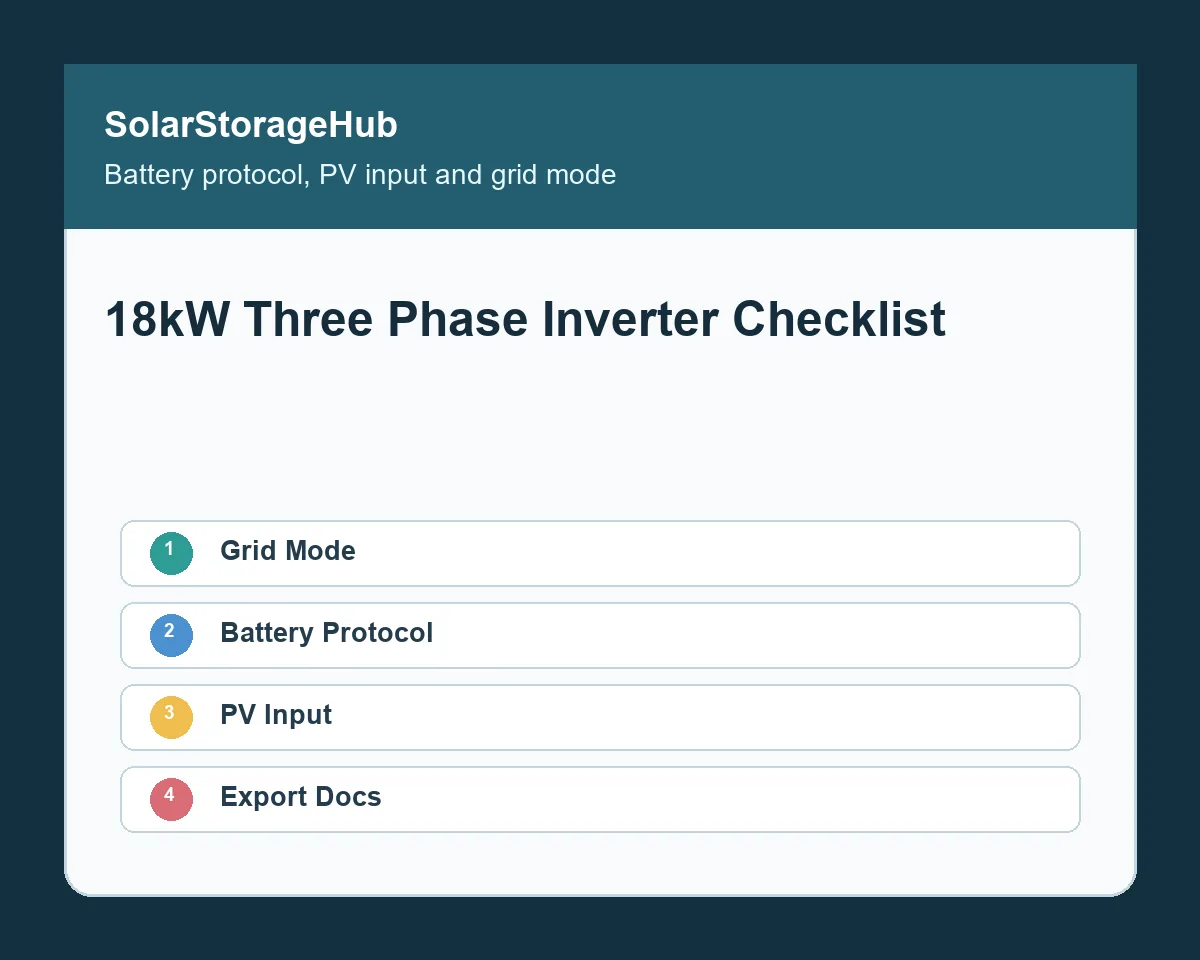
Confirm the inverter role before comparing models
The first question is not whether the inverter is 18kW. The first question is what the inverter must do on site. A three phase inverter may be used for residential villas, small commercial backup, PV self-consumption, peak shaving, or hybrid grid support. Each application changes the battery current, backup load, PV input, grid behavior, and monitoring requirements.
For example, a buyer may ask for an 18kW unit because the building has a high peak load, while the battery is only sized for short backup. Another buyer may need the inverter to run a stable daytime self-consumption profile with a larger battery. A third buyer may need export documents and model information for a specific country. The same inverter name can lead to different configuration questions, so the purchase process should start with application and site data.
18kW inverter buyer checklist
| Check item | What to request | Why it matters |
|---|---|---|
| AC output and grid mode | Rated output, phase, voltage, frequency range, grid standard, backup mode, overload limits, and transfer behavior. | Confirms whether the inverter can support the intended loads and local grid conditions. |
| Battery voltage and current | Battery voltage window, max charge current, max discharge current, compatible battery capacity, and protection limits. | Prevents a mismatch between inverter current demand and battery BMS limits. |
| Communication protocol | CAN or RS485 protocol, approved battery list, BMS register map, firmware version, and setup screenshots. | Reduces startup failures caused by communication mismatch. |
| PV input design | MPPT count, MPPT voltage range, max PV voltage, max string current, and PV oversizing guidance. | Protects the inverter and helps estimate real charging behavior. |
| Export and compliance | Datasheet, user manual, certificate list, label photo, packaging information, and country-specific documents. | Supports import, installation approval, and distributor documentation. |
| Commissioning support | Wiring diagram, parameter template, app or monitoring guide, remote support process, and troubleshooting flow. | Makes the field installation easier to repeat across projects. |
Match the battery before approving the inverter
Battery fit is the part buyers often underestimate. An inverter may accept the battery voltage on paper, but the BMS still needs to communicate correctly, report state of charge, handle charge/discharge limits, and protect the battery when temperature or voltage moves outside the safe range. For LiFePO4 storage, the buyer should ask for confirmed CAN or RS485 settings and a written note on compatible voltage platforms.
The solar inverter battery matching mistakes guide explains the common CAN, RS485, voltage and BMS errors. The solar battery storage inverter checklist gives a broader review of voltage, PV input and backup behavior. If the project uses a dedicated product, compare the checklist with the 18kW high frequency three phase solar inverter page.
PV input and 600W panel matching
PV input is another place where datasheet reading matters. A 600W panel or high-current module may need careful string planning because Voc rises in cold weather and current limits can be reached before the buyer expects it. The inverter MPPT range, maximum PV voltage, string current, and expected operating temperature should all be checked before the PV side is finalized.
For panel-side planning, review the solar panel category and the 600W foldable solar panel checklist. These pages help connect panel rating, Voc, MPPT behavior, cable loss, and battery charging expectations. Even when the project uses fixed PV modules rather than foldable panels, the same electrical checks are useful.
Documents buyers should collect before shipment
A good inverter quote should include the model datasheet, wiring diagram, communication protocol notes, supported battery list, user manual, monitoring guide, label photo, packaging information, and export document list. If the inverter is part of a larger storage order, the supplier should also explain whether the inverter, battery cabinet, and accessories are tested together before shipment.
For system-level planning, the power storage inverter checklist covers grid mode, battery protocol and export evidence. For external technical context, the U.S. Department of Energy solar and storage basics page is a useful reference on how storage fits into PV systems. SolarStorageHub uses this type of practical framing when reviewing inverter and battery assumptions before quotation.
Related buyer guide: Battery protocol and PV input must be reviewed when matching larger hybrid inverters. Read Home Battery Inverter Compatibility Checklist: Backup Load and PV Input.
Related buyer guide: Inverter protocol and PV input assumptions should be checked before commissioning. Read C&I ESS Commissioning Checklist: FAT, SAT, EMS and Warranty Handover.
Battery protocol and PV input compatibility do not complete the AC installation review. Use the 18kW three-phase solar inverter installation checklist to check the SLD, breaker and cable schedule, earthing, CT arrangement and pre-energization evidence.
FAQ
Is an 18kW inverter always suitable for a large battery?
No. The inverter power rating must be checked against battery voltage, BMS discharge current, charge current, backup load, and operating mode. A large battery can still be a poor match if communication or current limits are wrong.
Should I choose CAN or RS485 communication?
Use the protocol supported by both the inverter and battery BMS. Ask for a tested setup, firmware version, and parameter screenshots when possible. Communication details matter more than the protocol name.
What battery information should I send before buying the inverter?
Send battery voltage range, capacity, BMS brand, communication protocol, max charge and discharge current, intended backup load, and whether the battery is used for residential or C&I storage.
How do 600W panels affect inverter matching?
High-power panels can raise string current and cold-weather voltage concerns. Check Voc, temperature coefficient, MPPT voltage range, max PV voltage, and max string current before approving the PV layout.
What documents are useful for import and installation?
Request datasheet, user manual, wiring diagram, label photo, certificate list, packaging information, and any country-specific compliance documents required by the local installer or distributor.
Can SolarStorageHub review an inverter and battery combination?
Yes. Send the inverter model, battery model, voltage platform, BMS protocol, PV string plan, backup loads, and installation country through the contact page before final quotation.
Related SolarStorageHub Resources
If you are turning this article into a buying decision, compare the relevant product families and send your inverter model, target capacity, installation country, and quantity plan for confirmation.