
C&I ESS Supplier Qualification Checklist: FAT, PCS Scope and Warranty
A C&I ESS supplier qualification checklist should do more than ask for a product brochure. For a commercial or industrial battery project, the buyer needs to know who owns the battery cabinet design, who configures the PCS and EMS, who signs off the factory acceptance test, and who supports the site after delivery. A low cabinet price can look attractive at the quotation stage, but missing documents and unclear responsibility often become more expensive during commissioning.
This guide is written for distributors, EPC teams, installers, and OEM buyers comparing a C&I ESS supplier or manufacturer before a purchase order. Use it together with the C&I ESS product category, the outdoor battery storage cabinet, and the SolarStorageHub contact page when you need a project-specific review.
Start with supplier responsibility, not only factory photos
Factory photos can show assembly capability, but they do not prove that the supplier can support your project. For C&I energy storage, the supplier should be able to explain cell sourcing, BMS settings, PCS integration, cabinet thermal design, fire documentation, export packaging, warranty scope, and after-sales response. If one company builds the cabinet, another provides the PCS, and another handles software support, the responsibility map must be clear before shipment.
A practical qualification process starts by separating three roles. The first role is product manufacturing: cabinet assembly, wiring, battery module build, inspection, and packaging. The second role is system integration: PCS selection, EMS logic, communication settings, protection limits, and grid mode. The third role is project support: layout review, document preparation, remote commissioning support, spare parts, warranty handling, and troubleshooting. A strong supplier can show how these roles are covered.
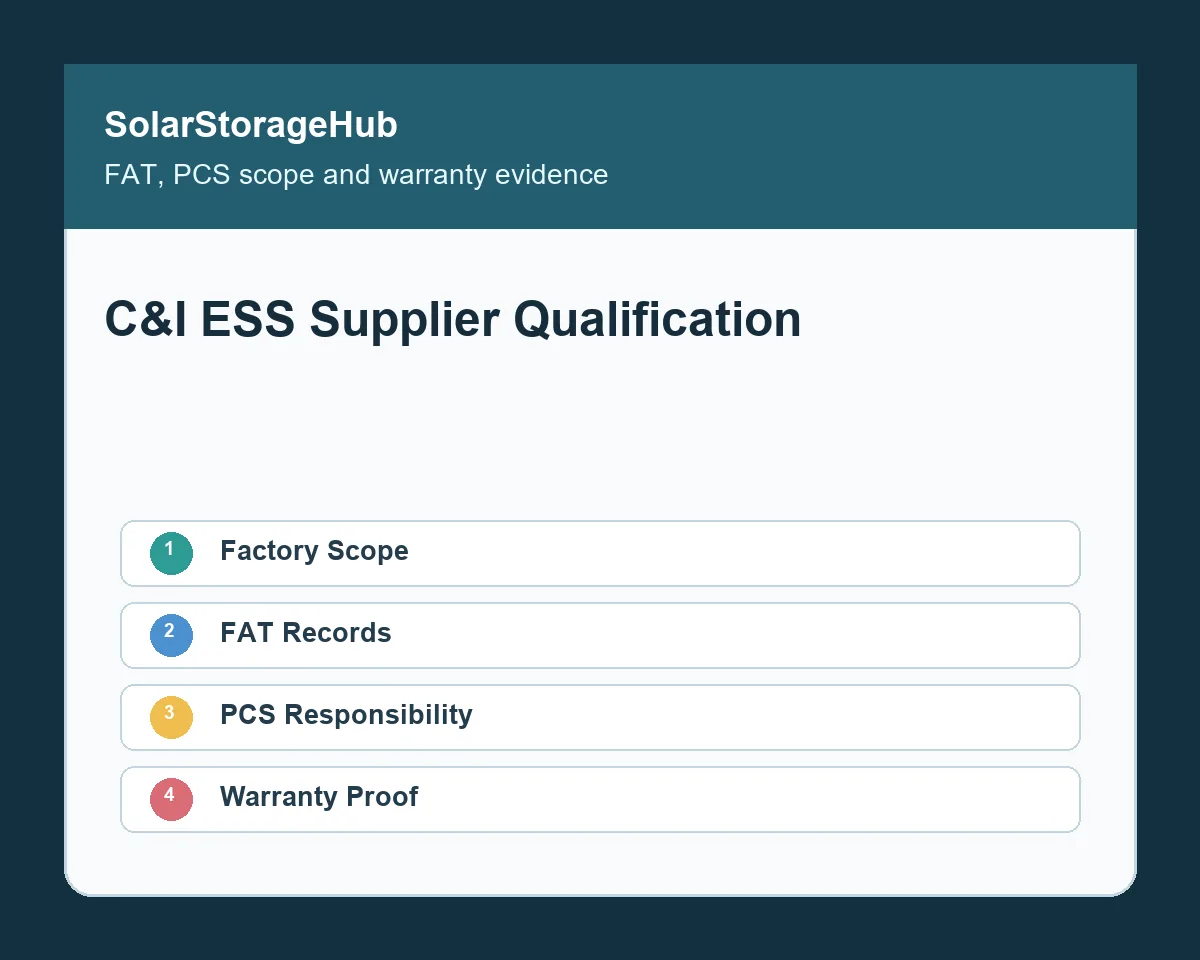
C&I ESS supplier qualification checklist
| Check item | What to request | Why it matters |
|---|---|---|
| Company and factory scope | Business license, factory address, production photos, test equipment list, and team responsibility chart. | Confirms whether the supplier is a manufacturer, integrator, trader, or mixed supplier. |
| Battery evidence | Cell specification, pack drawings, BMS brand, BMS parameter sheet, cycle-life basis, and traceable inspection records. | Connects the quoted capacity with the real battery build and warranty promise. |
| PCS and EMS scope | PCS model, rated power, overload limit, grid mode, EMS functions, communication protocol, and responsibility boundary. | Prevents confusion when a cabinet works electrically but does not match the site operating logic. |
| Thermal and enclosure design | Cooling method, HVAC access, IP rating basis, condensation control, installation clearance, and maintenance interval. | Outdoor and indoor C&I cabinets fail more often from heat, dust, water, and poor service access than from nominal capacity. |
| FAT and inspection | FAT procedure, insulation test, communication test, charging and discharging record, alarm test, and photo/video evidence. | Gives the buyer proof that the exact system was checked before shipment. |
| Certification and shipping | UN38.3, MSDS, dangerous goods declaration, packing list, label photos, and country-specific documents. | Reduces customs, insurance, and delivery delays. |
| Warranty and service | Warranty terms, exclusions, remote support process, spare parts policy, and required maintenance records. | Defines what happens after the cabinet is installed and operating. |
Ask for FAT evidence before paying the balance
A factory acceptance test should not be a single page with a stamp. For a C&I ESS cabinet or container, ask for a checklist that includes battery voltage, insulation, BMS communication, PCS startup, EMS display, emergency stop, fan or HVAC operation, alarm response, and discharge/charge records. The evidence does not need to be complicated, but it should connect the serial number, cabinet model, and shipment documents.
The C&I ESS factory audit checklist gives a deeper review of FAT evidence, and the C&I ESS manufacturer checklist explains how to compare factory documents and warranty support. For container projects, also review the 20ft and 40ft BESS container product path because layout, HVAC, fire documents, and transport constraints are different from cabinet projects.
Supplier qualification and FAT are only part of the quality picture. After the order, use the BESS quality assessment checklist to track cell incoming checks, assembly records, pre-shipment release, receiving inspection and site acceptance against the same project file.
Match the supplier to the project type
A small commercial peak-shaving system does not need the same review depth as a multi-container project, but the same logic applies. The supplier should understand the site load profile, backup requirement, grid phase, available PV capacity, installation environment, local electrical rules, delivery timeline, and service expectations. If the buyer cannot provide site data yet, the supplier should at least provide a clear list of missing information.
For residential-linked projects, compare the C&I offer with the home energy storage path so the battery voltage and backup logic are not mixed. If the project includes PV input or hybrid systems, confirm the solar inverter and solar panel assumptions as early as possible. A battery cabinet can be well built and still be the wrong choice if the site data and inverter plan are unclear.
Useful supplier questions before quotation
Ask who configures the BMS and PCS settings. Ask whether the supplier can share a sample FAT report with sensitive details removed. Ask how warranty claims are handled if the PCS, HVAC, or battery module fails. Ask whether the supplier can support remote commissioning. Ask which spare parts are normally shipped or stocked. Ask what project data is required before the final quotation. These questions are simple, but they reveal whether the supplier has worked through real C&I projects or is only reselling a cabinet.
For broader market and technical context, the NREL energy storage research section is a useful external reference. SolarStorageHub uses this type of technical framing when reviewing battery, inverter, certification, shipping, and installation assumptions for buyers before quotation.
Related buyer guide: Supplier qualification helps buyers verify FAT records, PCS scope and warranty responsibility. Read 20ft Energy Storage Container Checklist: 40ft BESS Layout and HVAC.
Related buyer guide: Supplier qualification should include FAT, PCS scope and warranty evidence. Read C&I ESS Fire Safety Checklist: HVAC, Warranty and Site Handover.
Related buyer guide: Supplier qualification helps confirm FAT, PCS scope and warranty evidence. Read C&I Battery Cabinet vs Container BESS: Sizing, HVAC and Site Layout Checklist.
Related buyer guide: Supplier qualification should connect FAT records with PCS scope and warranty evidence. Read C&I ESS Commissioning Checklist: FAT, SAT, EMS and Warranty Handover.
After the factory and FAT checks, use the C&I ESS exporter and wholesaler checklist to verify legal roles, order documents, packaging, Incoterms and warranty ownership before shipment.
FAQ
How do I know whether a C&I ESS supplier is a real manufacturer?
Ask for factory location, production process photos, test equipment, staff responsibility, and sample inspection records. A trading company can still be useful, but the buyer should know who actually builds, tests, and supports the system.
What is the most important document before shipment?
The FAT record is usually the most important operational document. It should show that the cabinet or container was powered, checked, and matched with the ordered configuration before shipment.
Should I choose the lowest C&I ESS cabinet price?
Not without checking scope. A lower price may exclude PCS, EMS functions, fire documents, cooling details, commissioning support, spare parts, or warranty coverage. Compare delivered scope, not only kWh capacity.
What project data should I send to a supplier?
Send load profile, backup target, grid phase, PV capacity, installation country, indoor or outdoor placement, preferred cabinet size, local compliance needs, and expected delivery timeline.
How does warranty evidence affect supplier selection?
A warranty is useful only when the operating conditions, exclusions, maintenance records, and support process are clear. Ask what evidence is required if a claim is filed after installation.
Can SolarStorageHub review a C&I ESS supplier quotation?
Yes. Share the quotation, product datasheet, PCS model, BMS details, site data, and document list through the contact page. The team can help identify missing technical and commercial items before order confirmation.
Related SolarStorageHub Resources
If you are turning this article into a buying decision, compare the relevant product families and send your inverter model, target capacity, installation country, and quantity plan for confirmation.