
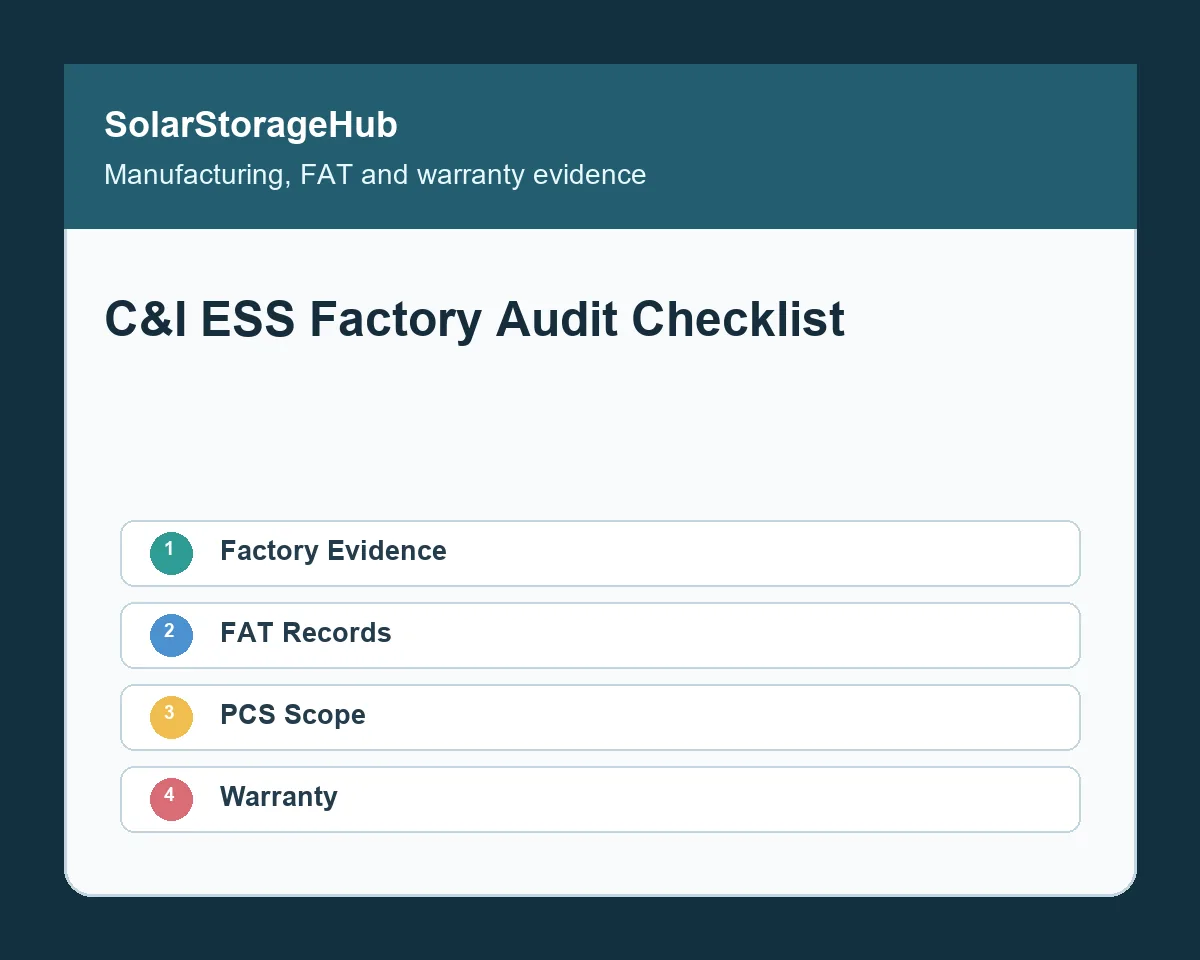
C&I ESS Factory Audit Checklist: Manufacturing, FAT and Warranty
A C&I ESS factory audit should prove more than the existence of a production line. For commercial and industrial energy storage buyers, the useful question is whether the supplier can document battery modules, BMS configuration, PCS scope, EMS logic, HVAC, fire safety, FAT records, shipping preparation and warranty support in a way that helps the project pass installation and handover. If the project includes PV charging, the audit should also connect battery and PCS scope with the Solar Panel plan. A low price without evidence can become expensive after delivery.
This checklist is written for distributors, EPC teams, project owners and OEM buyers comparing C&I ESS manufacturers, exporters and custom suppliers. It supports the C&I ESS category, Solar Inverter matching, Home Energy Storage planning and the Battery Storage Buyer Resources hub. Use it before paying a deposit or approving a repeat purchase.
Start with the project file, not the factory photos
Factory photos are useful, but they do not prove project readiness. A serious C&I ESS audit should begin with a project file: target kW, target kWh, load profile, grid voltage, transformer data, installation country, ambient temperature, site access, expected cycles, PV capacity, communication requirement and delivery schedule. Without this file, the supplier cannot confirm whether the proposed cabinet, container, PCS and EMS scope match the site.
Ask the supplier to map the project file to the product design. The audit should show which battery rack, BMS version, PCS rating, EMS control mode, HVAC capacity and fire-safety option are being quoted. If the system is custom, request the engineering change record and approval process. If the system is standard, request the exact model list and serial-number traceability plan. This is how a buyer separates a capable manufacturer from a reseller with incomplete technical control.
Check manufacturing evidence that survives after shipment
Useful manufacturing evidence should be specific enough to help after delivery. Request incoming cell inspection records, module assembly checks, BMS settings, torque records, insulation checks, wiring inspection, cabinet or container photos, serial-number mapping and final quality records. If the buyer cannot connect a shipped battery rack with the approved specification, warranty review becomes harder later.
The U.S. Department of Energy describes energy storage as a key tool for grid flexibility and reliability, but field performance depends on project design, controls and maintenance evidence. Reference: Energy.gov energy storage. For B2B buyers, factory evidence should help the owner operate and service the system, not only decorate a sales presentation.
C&I ESS factory audit checklist
| Audit item | What to request | Why it matters |
|---|---|---|
| Project file | Application, kW, kWh, load profile, grid data and site conditions. | Confirms whether the quoted ESS matches the actual project. |
| Manufacturing records | Cell checks, module records, wiring inspection and serial-number mapping. | Connects delivered equipment with the approved specification. |
| PCS scope | Rated kW, overload behavior, AC voltage, transformer interface and controls. | Prevents mismatch between storage output and site electrical limits. |
| FAT records | Charge-discharge test, communication test, alarm test and settings backup. | Shows whether the system was tested before shipping. |
| Fire documents | Detection, suppression, emergency stop and response information. | Supports safety review and site approval. |
| Warranty file | Warranty terms, exclusions, commissioning form and maintenance requirements. | Reduces dispute risk after installation. |
| Handover support | Manual, training file, monitoring access and spare part list. | Helps the owner operate the ESS after delivery. |
FAT should test the system the buyer will receive
Factory acceptance testing should not be a generic demonstration on unrelated equipment. Ask for FAT records tied to the project model or batch. Useful FAT evidence includes battery rack communication, PCS communication, EMS commands, charge-discharge response, emergency stop, HVAC alarms, fire-system status, insulation check, SOC display, data logging and alarm reporting. If the project will use remote monitoring, FAT should confirm which data fields and alarms are visible.
The FAT checklist should also record the settings that will be shipped. PCS mode, battery limits, EMS dispatch mode, export-control assumptions, communication protocol and protection settings should be backed up. For power sizing decisions, compare the audit with the C&I ESS PCS sizing checklist. For container projects, compare with the 40ft BESS container handover checklist.
Warranty evidence starts before commissioning
Warranty terms are often discussed too late. Buyers should request warranty period, cycle-life assumptions, depth-of-discharge rules, temperature limits, maintenance requirements, installation exclusions, remote monitoring requirements and claim evidence. If the warranty requires commissioning records or BMS logs, the supplier should provide the form before shipment, not after a failure.
A practical warranty file includes serial numbers, installation photos, wiring records, grid connection notes, battery settings, PCS settings, BMS logs and handover signatures. For fire-safety-related projects, also connect the warranty file with the C&I BESS fire safety document checklist. The better the file, the easier it is to resolve service questions without guessing.
Evaluate supplier support after the container leaves the factory
A supplier audit should include after-sales behavior. Ask who reviews site data, who approves wiring drawings, who supports commissioning, how remote troubleshooting works, how spare parts are supplied and how long technical response usually takes. If the supplier cannot explain support roles clearly, the project owner may struggle after delivery.
SolarStorageHub reviews C&I ESS manufacturing evidence, FAT records, PCS scope, fire documents, site data and warranty assumptions before quotation. If the project is still early, start with the C&I ESS quote checklist. For a supplier review, send project size, site location, grid data, load profile, required documents and target delivery date through the Contact page.
A factory audit is one quality gate, not the whole assessment. The BESS quality assessment checklist shows how to carry the same evidence through cell incoming checks, FAT, pre-shipment release, receiving inspection and site acceptance.
When a factory audit is worth the time
A factory audit is most valuable when the buyer is planning a repeat order, a custom cabinet, a containerized BESS, a public project, a distributor stock program or a project with strict safety review. It is also useful when quotations look similar but scope is unclear. The audit helps confirm whether the supplier can deliver the evidence the project will need later.
For small one-time orders, a lighter document review may be enough. For larger C&I projects, however, audit evidence protects the buyer from hidden scope gaps. The goal is not to collect paperwork for its own sake. The goal is to make sure manufacturing, shipment, installation, commissioning and warranty can be traced from one consistent project file.
Related buyer guide: Manufacturer evidence should include FAT records, warranty scope and traceable project files. Read Outdoor ESS Cabinet Manufacturer Checklist: Cost, Cooling and Evidence.
Related buyer guide: A factory audit gives buyers a practical way to review FAT records and warranty evidence. Read C&I ESS Supplier Qualification Checklist: FAT, PCS Scope and Warranty.
Related buyer guide: Factory audit evidence should connect the exact container with the ordered configuration. Read 20ft Energy Storage Container Checklist: 40ft BESS Layout and HVAC.
Related buyer guide: Factory audit records help verify manufacturing and test evidence. Read C&I ESS Fire Safety Checklist: HVAC, Warranty and Site Handover.
When the factory audit covers a container system, map the inspected model, FAT records and responsibility boundaries to the containerized battery energy storage system configuration proposed for the project.
Use the audit findings together with the C&I ESS manufacturing checklist to map factory-controlled scope, PCS and EMS responsibility, FAT traceability, safety documents and warranty handover.
FAQ
What is a C&I ESS factory audit?
It is a structured review of supplier manufacturing evidence, project documents, FAT records, safety information, warranty terms and after-sales support.
Is a factory photo enough?
No. Photos help, but buyers also need traceable records, model details, test evidence, settings backup and warranty conditions.
What should be included in FAT?
FAT should include charge-discharge response, communication tests, EMS commands, alarms, emergency stop, HVAC status, fire-system status and settings records.
Why does PCS scope matter in an audit?
PCS scope controls project power, grid connection, transformer limits and system behavior. Missing PCS details can make quotations hard to compare.
What warranty evidence should buyers keep?
Keep serial numbers, commissioning forms, BMS logs, installation photos, wiring records, settings files and maintenance records.
When should the audit happen?
Before deposit or final production approval, especially for custom C&I cabinets, container projects and repeat distributor orders.
Can SolarStorageHub help review supplier evidence?
Yes. Send project data, target system size, site conditions, required documents and quotation scope so the team can review gaps before ordering.
Related SolarStorageHub Resources
If you are turning this article into a buying decision, compare the relevant product families and send your inverter model, target capacity, installation country, and quantity plan for confirmation.