

20ft Energy Storage Container Checklist: 40ft BESS Layout and HVAC
A 20ft energy storage container is not just a larger battery cabinet. It is a project package that may include battery racks, PCS, EMS, HVAC, fire safety equipment, cable routing, lighting, service access, transport planning and commissioning records. A 40ft battery storage container adds more capacity and layout flexibility, but it also raises the importance of HVAC design, safety zoning, shipping clearance and site handover evidence.
This guide is for EPC teams, C&I storage buyers, distributors and project developers comparing 20ft and 40ft BESS container options before quotation. Use it together with the containerized BESS product page, the C&I ESS category, and the SolarStorageHub contact page when you need a container layout or document review.
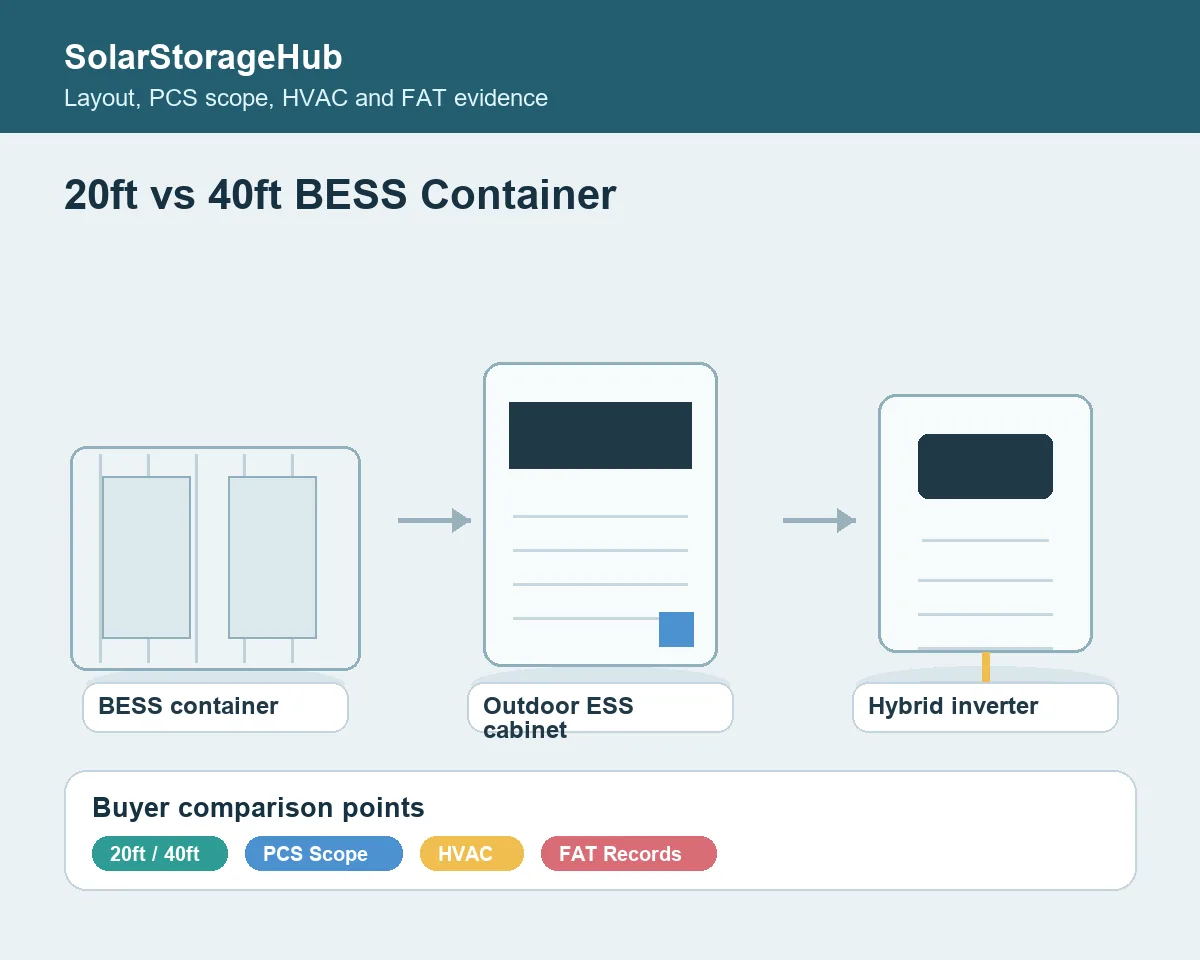
Choose 20ft or 40ft by site scope, not only capacity
The container size should follow the application, layout and maintenance plan. A 20ft energy storage container may fit smaller C&I sites, limited space, staged capacity expansion or projects where transport and crane access are tight. A 40ft BESS container can provide more space for battery racks, PCS room, HVAC, service aisle and fire system layout, but it needs more careful planning for delivery, foundation and site access.
Before asking for price, buyers should provide the target kWh, power rating, backup requirement, grid phase, PV capacity if present, installation country, ambient temperature, available foundation space, delivery access and preferred commissioning timeline. Without these details, the supplier can only quote a generic container, not a project-ready system.
20ft and 40ft BESS container checklist
| Check item | What to request | Why it matters |
|---|---|---|
| Container layout | Battery rack layout, service aisle, PCS/EMS position, HVAC location, fire system and cable routing drawing. | Confirms whether the container can be installed and serviced safely. |
| PCS scope | PCS power rating, overload limit, grid mode, transformer assumptions, EMS functions and communication boundary. | Prevents confusion between battery capacity and usable site power. |
| HVAC and cooling | Cooling method, airflow path, filter access, design temperature, condensation handling and maintenance interval. | Controls battery reliability and warranty conditions in outdoor operation. |
| Fire safety documents | Detection method, suppression system, alarm logic, emergency stop and document list for the destination market. | Helps buyers prepare local installation and safety review. |
| FAT evidence | Insulation test, BMS communication, PCS startup, EMS display, HVAC operation, alarm test and serial number photos. | Shows that the actual system was tested before shipment. |
| Shipping and site access | Container dimensions, weight, lifting points, packing scope, delivery route limits and foundation requirements. | Reduces project delay caused by transport or unloading problems. |
| Warranty and service | Warranty scope, exclusions, required maintenance records, spare parts and remote support process. | Defines who supports the container after commissioning. |
Do not separate PCS sizing from container layout
Container buyers often discuss capacity first and PCS later. In practice, PCS sizing affects cable route, heat load, transformer assumptions, service space, control logic and commissioning process. The battery can be correctly sized for kWh while the PCS is still wrong for the load profile or grid conditions. This is why the PCS rating, overload behavior, reactive power needs, grid phase and transformer plan should be reviewed before the layout is approved.
The 40ft BESS container checklist gives a deeper look at layout, PCS, HVAC and handover. The C&I ESS PCS sizing guide explains kW, kWh, overload, reactive power and transformer questions that often appear before final quotation.
FAT and handover evidence should match the exact container
A strong factory acceptance test should connect the container serial number, battery racks, PCS model, EMS version, HVAC equipment, fire system and shipment documents. Ask for photo or video evidence where possible. The buyer does not need a complicated report for every small project, but the final evidence should prove that the delivered container matches the agreed design.
Before approving that FAT package, use the C&I ESS manufacturing checklist to map battery, BMS, PCS, EMS, enclosure and test responsibility to the factory or integrator that controls each part of the quoted container.
For supplier review, the C&I ESS supplier qualification checklist and C&I ESS factory audit checklist help buyers compare factory scope, FAT records, warranty responsibility and document quality. If the project is smaller than container scale, compare the same requirements with an outdoor battery storage cabinet.
Site survey data makes the quote more reliable
A container quote becomes more reliable when the buyer provides load profile, peak demand, daily energy target, backup duration, PV input, installation temperature, altitude, available footprint, foundation plan, cable distance, grid phase, local standards and expected delivery route. Missing data usually leads to broad assumptions, and broad assumptions lead to change orders or commissioning delays.
If the container is part of a solar + storage project, do not treat PV and inverter details as separate paperwork. The solar inverter plan affects PCS communication, AC coupling or hybrid system logic, monitoring and backup behavior. The solar panel layout affects PV capacity, cable routing, charging profile and site space. These details should be checked before the container layout is frozen.
For general storage project context, the NREL energy storage research section is a useful external reference. SolarStorageHub uses this project-first approach when reviewing container layout, PCS scope, HVAC requirements and documentation before quotation.
Related buyer guide: Container layout and HVAC should be checked before selecting a BESS container. Read C&I ESS Fire Safety Checklist: HVAC, Warranty and Site Handover.
Related buyer guide: Container BESS buyers should compare layout, HVAC and service access before ordering. Read C&I Battery Cabinet vs Container BESS: Sizing, HVAC and Site Layout Checklist.
FAQ
When should I choose a 20ft energy storage container?
A 20ft container can fit projects with moderate capacity needs, limited site space, staged deployment or tighter transport access. The final choice depends on battery capacity, PCS location, service aisle and cooling layout.
When is a 40ft BESS container better?
A 40ft container is usually better when the project needs more capacity, more service space, integrated PCS/HVAC layout, or a larger system that should be shipped as a more complete package.
What layout drawing should I request?
Ask for battery rack position, PCS/EMS area, HVAC location, cable route, fire system, emergency stop, service aisle, door direction and lifting/installation notes.
Why is HVAC important for containerized BESS?
HVAC controls operating temperature, humidity and airflow. Poor cooling design can reduce battery performance, increase alarms and create warranty disputes after installation.
What FAT evidence is useful before shipment?
Ask for insulation test, BMS communication test, PCS startup, EMS display, HVAC operation, alarm test, emergency stop check, serial number photos and packing evidence.
Can SolarStorageHub review a BESS container quotation?
Yes. Send target kWh, PCS power, layout drawing, site country, load profile, PV capacity, delivery conditions and supplier documents through the contact page.
Related SolarStorageHub Resources
If you are turning this article into a buying decision, compare the relevant product families and send your inverter model, target capacity, installation country, and quantity plan for confirmation.