
C&I BESS Fire Safety Checklist: Detection, Suppression and Emergency Documents
Procurement note: A fire-safety statement in a brochure is not a project safety package. C&I battery storage buyers need model-specific test evidence, detection and control descriptions, site drawings, emergency procedures, commissioning records and maintenance responsibilities before equipment is delivered.
This checklist is written for EPC teams, facility owners, distributors and project developers comparing C&I ESS, Solar Inverter, Solar Panel, and larger Home Energy Storage systems. Use it with the Battery Storage Buyer Resources hub and submit the site and equipment package through Contact.
Why fire-safety documents must be project-specific
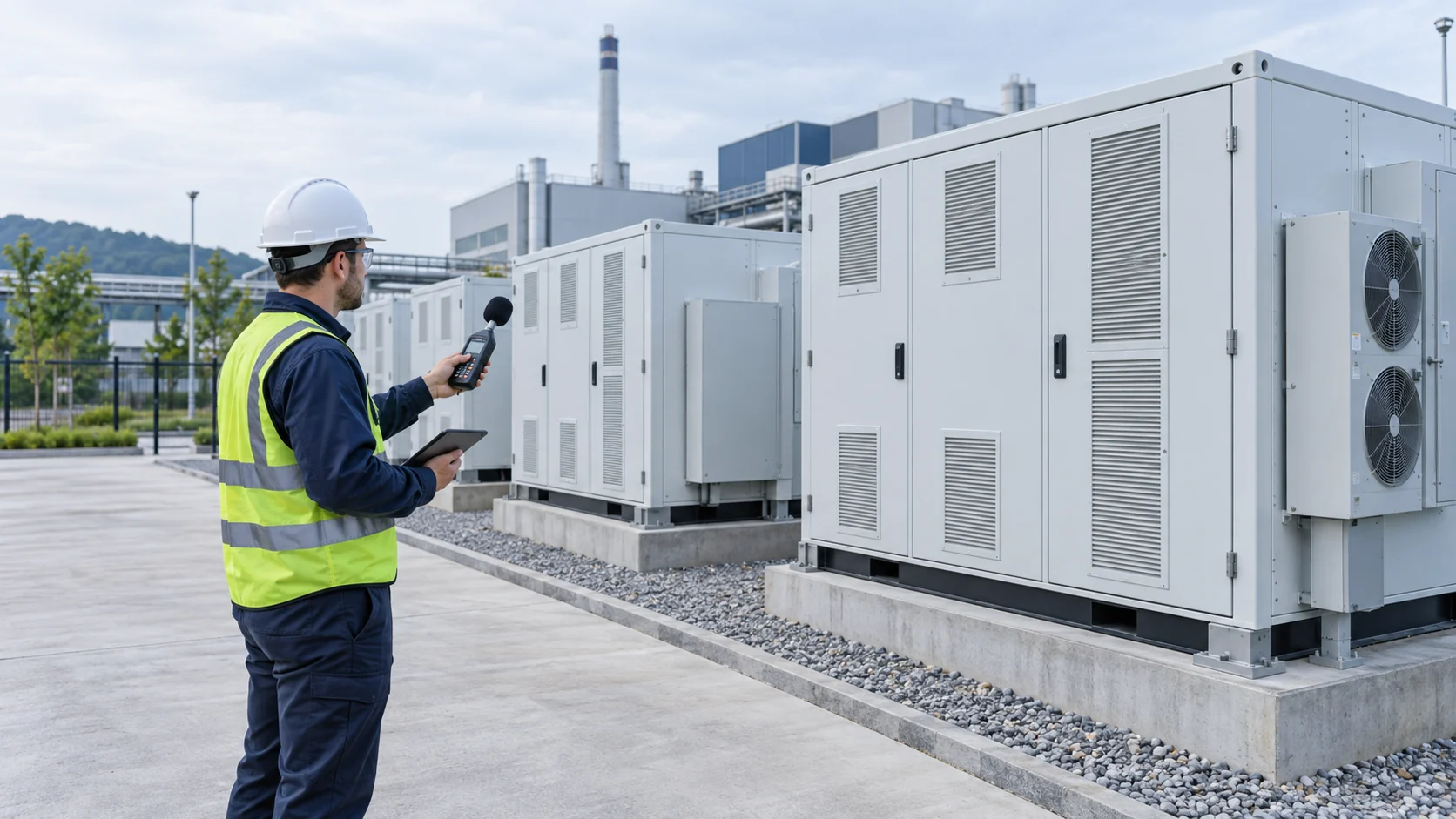
Battery chemistry is only one part of system safety. Cell format, module spacing, enclosure design, ventilation, cooling, electrical protection, detection, control logic, installation distance and emergency access all influence risk. A report for one model or configuration should not automatically be applied to another cabinet or container.
Requirements also vary by country, authority having jurisdiction, insurer, utility and site use. The supplier package should support the responsible local team, not replace its risk assessment or approval process. Buyers should identify required documents before the quotation is finalized so safety items are not treated as late extras.
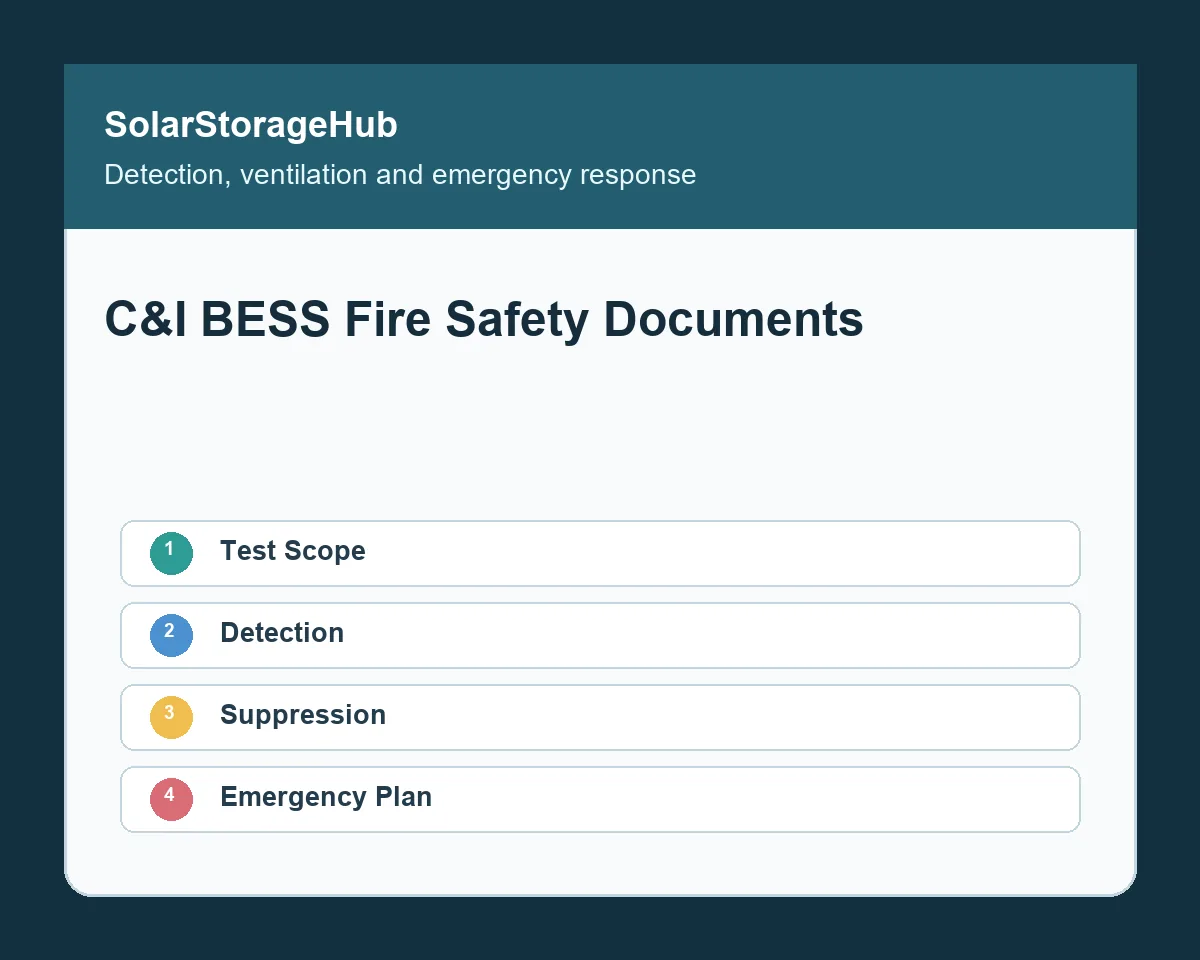
C&I BESS fire-safety document checklist
| Document group | What to request | What to verify |
|---|---|---|
| Product identity | Model, capacity, cell, module, rack, enclosure, firmware and serial-number rules. | All reports and drawings match the quoted configuration. |
| Test evidence | Applicable system and propagation test reports, certificates and report scope. | Model names, energy, enclosure and test body are consistent. |
| Detection | Smoke, heat, gas or off-gas sensors, alarm thresholds and fault monitoring. | Sensor location, power supply, outputs and maintenance method. |
| Ventilation | Normal ventilation, emergency ventilation and shutdown interlocks. | Air path, weather protection, control logic and site restrictions. |
| Suppression | System type, activation logic, design basis, interfaces and service schedule. | Coverage and limitations for the quoted cabinet or container. |
| Emergency response | Alarm actions, isolation, access control, responder information and contacts. | Site-specific roles, language, signage and communication. |
| Commissioning | Cause-and-effect test, alarm test, emergency stop and communication records. | Every input and output is witnessed and documented. |
| Maintenance | Inspection frequency, sensor replacement, suppression service and log retention. | Responsibility, spare parts and qualified service provider. |
Confirm that test evidence matches the quoted product
Start with product identity. Compare the quotation, datasheet, nameplate, cell, module, rack, enclosure and rated energy against the certificate and test report. If the project uses a private-label name, ask how it maps to the tested model. If capacity, spacing, cooling or enclosure changes, request written confirmation of the applicable scope.
The Battery Certification Documents guide explains how buyers can compare model names and report scope. Do not treat a logo on a sales sheet as equivalent to the underlying report and project approval.
Document detection and alarm logic
Request a sensor list showing type, location, quantity, power supply and communication. The package should explain normal status, warning, alarm, fault and loss-of-communication behavior. If gas or off-gas detection is provided, ask which condition it detects and what automatic actions follow.
A cause-and-effect matrix should connect each input to outputs such as local alarm, remote notification, HVAC action, PCS shutdown, battery contactor action, emergency ventilation or suppression activation. The responsible safety team must review whether those actions are appropriate for the site.
Review ventilation and pressure management
Normal thermal management and emergency ventilation are different functions. Cooling maintains operating temperature; emergency ventilation may be intended to manage a hazardous atmosphere under defined conditions. Buyers should ask for airflow paths, fan duty, weather protection, control logic, power supply and failure alarms.
Do not add openings or fans without supplier and engineering review. Changes can affect enclosure protection, cooling balance, tested configuration and propagation behavior. Site drawings should show intake, exhaust, nearby doors, occupied areas, ignition sources and responder access.
Understand what suppression can and cannot do
A suppression system is one layer of a broader design. Buyers should request its design basis, agent or method, protected volume, release logic, manual controls, alarms, service interval and integration with ventilation and shutdown. The documentation should state limitations rather than promising that one device eliminates all battery risk.
Ask who designs and certifies the site installation, who commissions it and who services it after handover. If the project requires water supply, external fire-service access or separation measures, those responsibilities should appear in the site scope and budget.
Create a site-specific emergency response plan
The emergency plan should identify alarm recipients, isolation steps, evacuation or access restrictions, emergency contacts, responder information, site map, equipment location and hazards. It should be written for the actual site language and staffing pattern, including nights and weekends.
Responders need accurate information without being asked to diagnose the battery remotely. Provide equipment identity, stored energy, isolation points, emergency-stop location, access route and supplier contact. Coordinate the plan with the authority having jurisdiction and local emergency services where required.
Integrate fire safety with electrical protection
Fire-safety controls must coordinate with the battery management system, PCS, DC protection, AC protection, HVAC and site controller. Define what happens when the system detects overtemperature, smoke, gas, insulation fault, communication loss or emergency stop. Shutdown should not create another uncontrolled condition.
The C&I ESS PCS Sizing Checklist covers converter, transformer and grid limits. The BMS Parameters Buyer Checklist helps buyers document battery-side thresholds and current limits.
Turn the cause-and-effect matrix into commissioning tests
Commissioning should verify every agreed alarm and output without creating unsafe conditions. Test sensor faults, communication loss, local alarm, remote notification, HVAC response, PCS command, contactor response, emergency stop and reset permissions according to the approved procedure.
Save timestamps, screenshots, controller logs, photos, signatures and unresolved items. The C&I Battery Energy Storage Commissioning Checklist provides a wider commissioning record. Any failed safety test should be closed before normal operation.
Plan inspection and maintenance before handover
Detection and suppression components require inspection, calibration, replacement or service. The supplier should state intervals, qualified service requirements, spare parts, test methods and record retention. The owner should know which tasks can be performed by site staff and which require a specialist.
Include filters, fans, seals, cable entries, corrosion, water ingress, sensor status, alarms and emergency signage in routine checks. Use the C&I ESS Maintenance Checklist to connect safety systems with BMS logs, cooling and warranty records.
Use current standards and local approval requirements
Project teams should consult current editions and local requirements rather than copying a checklist from another jurisdiction. Useful official references include the UL 9540A test method information, UL Solutions energy storage testing and certification, and the NFPA 855 standard development page.
These references do not prove that a specific product or site is approved. The authority having jurisdiction, insurer and responsible engineers determine the applicable requirements and acceptance process.
What to send before requesting a BESS quotation
Prepare the installation country, site use, cabinet or container location, target energy and power, equipment model, layout, separation distances, access routes, ambient conditions, utility requirements, insurer requirements and known local safety standards. State whether detection, ventilation, suppression and remote monitoring are expected in the supplier scope.
SolarStorageHub can organize the supplier documentation and quotation assumptions for buyer review; final fire strategy, emergency planning and regulatory approval remain with the responsible local parties. Submit the project package through Contact.
The outdoor battery storage cabinet page connects fire-safety documentation with the equipment and project items that affect a complete quotation. View the product and buyer checks.
Related buyer guide: Container selection should include fire-safety evidence, detection, ventilation and emergency documents. Read 20ft vs 40ft BESS Container: Capacity, Layout, Shipping and Commissioning Checklist.
Related buyer guide: Fire-safety documents should be checked before accepting a manufacturer quotation. Read C&I ESS Manufacturer Checklist: Factory Evidence, Documents and Warranty.
Related buyer guide: Fire-safety scope can change outdoor cabinet cost and approval requirements. Read Outdoor Cabinet Energy Storage System Cost Checklist.
Related buyer guide: Outdoor cabinet projects should include fire detection, suppression and emergency documentation. Read Outdoor AC Energy Storage Cabinet Checklist: Cooling, IP Rating and PCS.
Related buyer guide: Fire detection, suppression and emergency documents should be reviewed before site approval. Read 40ft BESS Container Checklist: Layout, PCS, HVAC and Site Handover.
Related buyer guide: Fire detection, suppression and emergency documents should be part of the audit file. Read C&I ESS Factory Audit Checklist: Manufacturing, FAT and Warranty.
Related buyer guide: Fire detection, suppression and emergency documents should be reviewed before site approval. Read Outdoor ESS Cabinet Manufacturer Checklist: Cost, Cooling and Evidence.
Related buyer guide: Fire detection, suppression and emergency records should be reviewed with outdoor cabinet service. Read Outdoor AC Energy Storage Cabinet: Temperature and Maintenance Checklist.
FAQ
Is a battery certificate enough for project fire approval?
No. Project approval may also require test reports, site design, separation, detection, ventilation, suppression and emergency planning.
What is a cause-and-effect matrix?
It documents how each alarm or fault input triggers outputs such as notification, shutdown, ventilation or suppression.
Does every BESS require the same suppression system?
No. Requirements depend on equipment design, test evidence, site conditions and the authority having jurisdiction.
Why should report model names match the quotation?
Different cells, modules, capacities or enclosures may not be covered by the same test evidence.
Should emergency ventilation run during every alarm?
Not automatically. The approved design should define when ventilation starts and how it coordinates with detection and suppression.
What fire-safety items should be commissioned?
Verify alarms, faults, notifications, shutdown commands, emergency stop, ventilation or suppression interfaces and reset permissions.
Who approves the final fire-safety design?
The applicable local authority, responsible professionals, insurer and other project stakeholders determine approval requirements.
Related SolarStorageHub Resources
If you are turning this article into a buying decision, compare the relevant product families and send your inverter model, target capacity, installation country, and quantity plan for confirmation.