
Floor Mounted Energy Storage System Checklist: 5kWh, Wiring and Setup
A floor mounted energy storage system is often chosen when buyers want a practical home or small commercial battery that is easier to place and service than a compact wall unit. The format can work well for 5kWh, 10kWh, 15kWh and larger floor-standing batteries, but the installation still needs careful checking. Capacity, wiring, inverter fit, BMS settings, floor space, ventilation, PV recharge and warranty records should be confirmed before ordering.
This checklist is written for distributors, installers, OEM buyers and project teams comparing floor mounted LiFePO4 battery storage systems. It supports Home Energy Storage, Solar Inverter, Solar Panel, C&I ESS and the Battery Storage Buyer Resources hub.
Start with the exact battery role
A 5kWh floor mounted battery can serve a different role than a 15kWh or 30kWh battery. It may support selected backup loads, solar self-consumption, off-grid equipment, distributor stock or a small demonstration system. The buyer should define the application before comparing product photos. A small backup system may need stable EPS output and clear critical-load planning. A solar self-consumption system may need better PV recharge assumptions and daily cycle planning.
Ask for nominal capacity, usable capacity, voltage platform, BMS communication, charge current, discharge current, cycle-life claim and supported inverter list. If the buyer plans future expansion, confirm parallel rules, cable size, communication setup and maximum allowed units. A system that works as one 5kWh unit may need different wiring and settings when expanded.
Wiring and inverter fit decide whether setup is smooth
Floor mounted systems usually need DC power cables, communication cable, breaker or fuse, grounding and inverter settings. Confirm cable length, cable size, terminal type, polarity labels, recommended torque and cable exit direction. If the battery sits close to a wall, make sure the installer can still access terminals and labels. If several units are installed side by side, keep enough service space and avoid cable crossing.
The inverter must match battery voltage, current and protocol. The U.S. Department of Energy explains that inverters manage power conversion and grid interaction in solar energy systems. Reference: Energy.gov inverter basics. For a floor mounted energy storage system, that means the inverter should be checked with the exact BMS protocol, not only with the battery chemistry name.
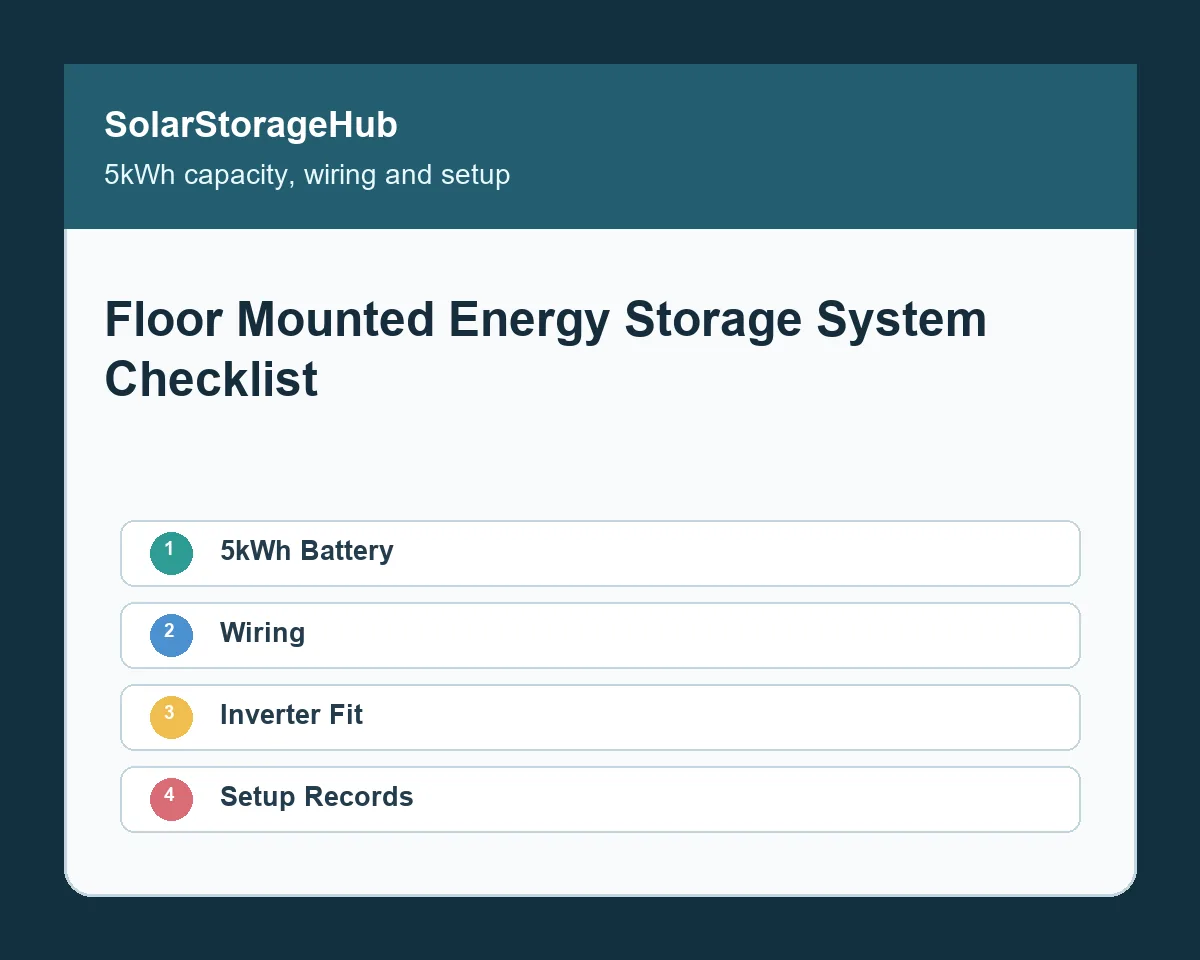
Floor mounted energy storage system checklist
| Check item | What to request | Why it matters |
|---|---|---|
| Capacity | Nominal kWh, usable kWh, voltage and recommended depth of discharge. | Separates catalog capacity from practical backup runtime. |
| Floor space | Dimensions, weight, clearance, anti-tip method and service access. | Confirms whether the system can be installed and maintained safely. |
| Wiring | Cable size, cable length, breaker, fuse, grounding and terminal details. | Prevents voltage drop, heat and field wiring mistakes. |
| Inverter fit | Battery voltage range, charge current, CAN or RS485 and firmware notes. | Reduces BMS communication and SOC display problems. |
| PV recharge | PV capacity, MPPT limits, charge current and expected sun hours. | Shows whether the battery can recover after daily use. |
| Setup records | Photos, settings backup, BMS logs and commissioning form. | Creates evidence for warranty and service support. |
| Shipping proof | Label photo, packing photo, accessory list and documents. | Connects delivered goods with the approved order. |
Check 5kWh, 10kWh and 15kWh as a system family
Distributors often stock multiple capacity options. The buyer should know whether 5kWh, 10kWh and 15kWh products use the same cabinet, same BMS, same inverter protocol and same accessories. If models share parts, after-sales support is easier. If each model has different settings, the supplier should provide clear model-by-model wiring diagrams and inverter parameters.
Runtime expectations should also be separated by capacity. A 5kWh system may support essential circuits or a small load group. A 10kWh or 15kWh system may support longer backup or larger daily self-consumption. Compare the decision with the 5kWh, 10kWh and 15kWh floor mounted solar battery checklist and the floor mounted battery wiring and inverter fit checklist.
PV recharge should be realistic
Solar recharge depends on panel wattage, MPPT input, weather, cable length, shading and battery charge limits. If the project uses a hybrid inverter, check MPPT voltage range, maximum PV voltage, maximum current and battery charge current. If the project uses a separate solar charge controller, confirm controller compatibility and wiring protection. A battery that runs loads well may still take too long to recharge if PV is undersized.
For panel matching, review the solar panel and battery storage matching guide. For battery and inverter communication, review the solar inverter and battery matching mistakes checklist. SolarStorageHub reviews capacity, PV recharge, inverter fit, installation records and warranty assumptions before quotation.
Installation records protect both buyer and supplier
Many after-sales problems are easier to solve when installation evidence is complete. Ask the installer to keep photos of the battery label, cable route, breaker, grounding, inverter screen, BMS communication, SOC display, alarms and final setup. If the system is shipped for distributor stock, keep packing photos, accessory lists and serial number records.
Warranty terms should explain operating temperature, installation location, BMS logs, allowed parallel quantity, maintenance requirement and excluded use cases. If the buyer needs support for OEM or repeat stock, request a standard commissioning form and troubleshooting workflow before the first batch ships. For a project review, send target capacity, inverter model, PV plan, country, load list and quantity through the Contact page.
When a floor mounted system is the right choice
A floor mounted system is useful when the buyer wants more capacity than a compact wall battery, easier service access, a cabinet-like format and possible future expansion. It can work well in garages, utility rooms, small commercial spaces and distributor showrooms. It is also easier to explain to some customers because the physical layout is visible and accessible.
It is not always the best format. Wall batteries can save floor space. Rack batteries may be better for equipment rooms with many modules. Outdoor cabinets are better when the system must sit outside. The correct format depends on space, service access, wiring route, capacity, inverter choice and site environment.
Related buyer guide: Wiring setup affects safe installation and usable backup power. Read Home Battery Inverter Compatibility Checklist: Backup Load and PV Input.
Related buyer guide: Compare the product specifications with the 5kWh wiring, setup and inverter-fit checklist. Read 5kWh, 10kWh & 15kWh Floor-Mounted Solar Battery.
FAQ
What is a floor mounted energy storage system?
It is a battery storage system designed to stand on the floor, usually in a cabinet-style or upright enclosure.
Is 5kWh enough for home backup?
It can support selected essential loads, but runtime depends on usable energy, inverter output, load size and recharge plan.
What should be checked before wiring?
Check cable size, cable length, breaker or fuse, grounding, terminal access, polarity and communication cable requirements.
Can floor mounted batteries connect in parallel?
Many can, but the buyer must confirm allowed quantity, cable method, BMS communication, current limits and firmware settings.
What causes inverter mismatch?
Common causes include wrong voltage range, unsupported CAN or RS485 protocol, charge-current limits and untested firmware.
What installation evidence should be kept?
Keep label photos, wiring photos, breaker photos, inverter settings, BMS logs, SOC screenshots and commissioning records.
When should SolarStorageHub review the system?
Before order confirmation, especially when the buyer must match a battery with a specific inverter, PV array or distributor stock plan.
Related SolarStorageHub Resources
If you are turning this article into a buying decision, compare the relevant product families and send your inverter model, target capacity, installation country, and quantity plan for confirmation.