
Floor Mounted Battery Checklist: Space, Wiring and Inverter Fit
A floor mounted battery is often easier to service than a small wall battery, but it is not automatically easier to install. Buyers still need to confirm floor space, cable routing, ventilation, inverter matching, BMS communication, shipping handling and warranty evidence before the order is placed. This checklist is written for distributors, installers and OEM buyers who are comparing LiFePO4 floor batteries for residential backup, small commercial solar storage and repeat stock programs.
The main risk is assuming that capacity alone defines the purchase. A 5kWh, 10kWh, 15kWh or 30kWh floor mounted battery can look simple in a catalog, but the project may fail if the footprint blocks service access, if the inverter cannot read the BMS, if the battery cannot deliver the required discharge current, or if the installer cannot keep cables protected. Use this guide with the Home Energy Storage category, the Solar Inverter category and the Battery Storage Buyer Resources hub when checking a real quotation.
Start with the floor space, not the battery label
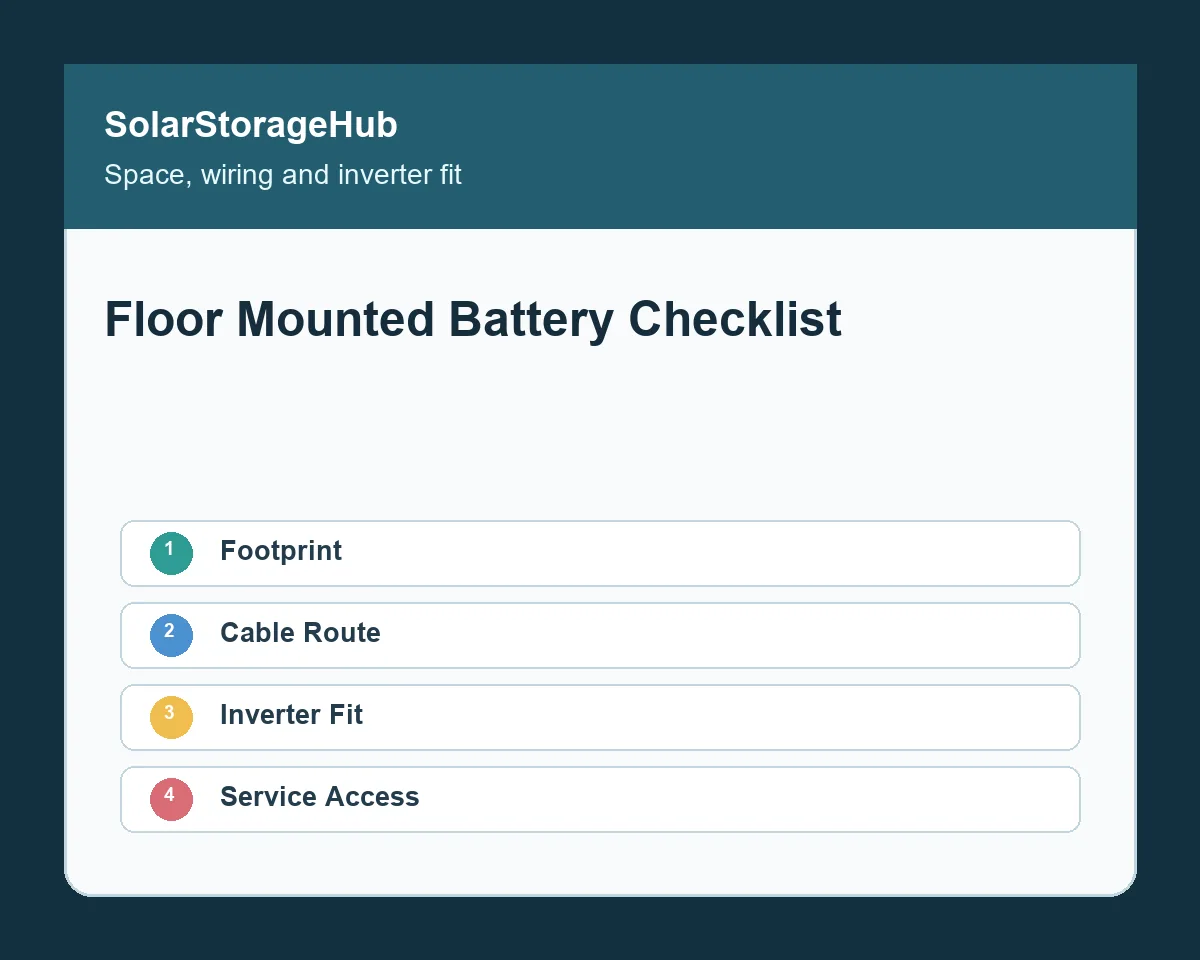
A floor mounted battery needs a stable, dry and accessible location. Before comparing price, request the product dimensions, net weight, suggested clearance, wall distance, floor loading requirement and cable exit direction. These details matter because many projects are installed in garages, utility rooms, basements, small equipment rooms or light commercial service areas. A battery that fits the floor plan may still be difficult to commission if the door swing, cable tray, breaker box or inverter location blocks access to the service panel.
Ask whether the battery is designed to stand alone, bolt to the wall for anti-tip protection, connect in parallel, or connect with a dedicated base. If the project may expand later, confirm whether the layout can add another unit without crossing cables or covering labels. Buyers planning distributor stock should also compare packaging size, pallet quantity and lifting method, because a battery that is easy to sell on paper may be costly to move in the warehouse.
Check battery voltage and inverter fit before approving capacity
The inverter must support the battery voltage window, communication method and charge-discharge current. For a 51.2V floor mounted LiFePO4 battery, confirm the inverter low-voltage battery range, maximum charge current, maximum discharge current, CAN or RS485 protocol, recommended BMS settings and firmware version. For a high-voltage floor battery, confirm the allowed module count, operating voltage range, master control unit and compatible inverter list. The U.S. Department of Energy notes that inverters are a key part of solar energy systems because they convert and manage power between the array, loads and grid, so inverter selection should not be treated as an accessory decision. Reference: Energy.gov inverter basics.
Inverter fit should be tested with the exact battery model, not only the chemistry name. LiFePO4 is a chemistry, not a complete communication standard. Ask the supplier for the inverter brand list, tested protocol file, charge voltage, discharge cut-off, SOC display behavior, alarm list and recovery behavior after over-current or low-temperature protection. If the customer already has an inverter, send the inverter model, firmware version and wiring plan before the battery is selected.
Floor mounted battery buyer checklist
| Check item | What to request | Why it matters |
|---|---|---|
| Footprint | Dimensions, weight, clearance and cable exit direction. | Confirms whether the battery can be installed and serviced in the planned location. |
| Voltage platform | Nominal voltage, operating range and parallel limits. | Prevents mismatch with the selected inverter or future expansion plan. |
| BMS communication | CAN or RS485 protocol, inverter list and firmware notes. | Controls SOC reading, charge current, alarms and protection behavior. |
| Discharge power | Continuous current, peak current and recommended load limit. | Shows whether backup loads can start without tripping battery protection. |
| Installation clearance | Front access, side clearance, ventilation and floor condition. | Supports safe wiring, inspection and warranty service. |
| Documentation | Datasheet, manual, wiring diagram, test report and label photo. | Gives distributors and installers usable evidence before shipment. |
| Warranty evidence | Commissioning form, BMS log requirement and photo records. | Reduces disputes if a later warranty claim depends on installation proof. |
Plan cables and protection before the battery arrives
Cable routing is a common weak point in floor mounted installations. Ask the supplier whether cables exit from the top, side, rear or bottom, and confirm the recommended cable size, breaker, fuse, DC isolator, grounding method and communication cable type. The installer should know whether the battery terminals are accessible after the unit is placed in its final position. If the battery sits near a wall, tight corners can make torque checks and polarity checks harder than expected.
For backup applications, the battery should be checked against the actual load list. Refrigerators, pumps, motors and compressors can have starting current higher than their running load. A battery with enough kWh may still trip if its discharge power is too low. When the buyer is unsure, compare the battery with the 5kWh, 10kWh and 15kWh floor mounted solar battery runtime checklist and the solar panel and battery storage matching checklist.
Do not separate product selection from shipping and service
Floor mounted batteries are heavier than small wall batteries, so packaging and after-sales records deserve attention. Request pallet photos, carton structure, label position, accessory list and loading method. For international distribution, also confirm required shipping documents, UN38.3, MSDS, commercial invoice details, packing list and battery handling marks. A good product page should help the buyer understand the battery, but a good order file should prove exactly what was shipped.
Service evidence also matters for E-E-A-T. SolarStorageHub reviews battery specifications, inverter compatibility, installation limits, shipping records and warranty assumptions before quotation. For larger or mixed projects, compare this floor battery decision with C&I ESS, Solar Panel and the Contact page so the supplier can check the complete system rather than one part in isolation.
When a floor mounted battery is the better choice
A floor mounted battery is often a strong choice when the project needs more capacity than a compact wall battery, when future parallel expansion is likely, when service access is important, or when the customer prefers equipment that can be moved without changing the building wall. It may also be easier for distributors to explain to buyers because the installation format feels similar to an appliance or cabinet.
It is not the best choice for every project. If wall space is available but floor space is limited, a wall mounted battery may be cleaner. If many modules must be stacked in an equipment room, a rack system may be easier to organize. If the project needs outdoor placement, confirm enclosure rating, temperature control and local installation rules before using an indoor floor battery. The right answer depends on the site, not only on the battery capacity.
Related buyer guide: Floor space, cable route and service access must be checked before approving a 30kWh floor battery. Read 30kWh LiFePO4 Battery Checklist: 600Ah, Runtime and Inverter Fit.
Related buyer guide: Floor space, wiring and inverter fit should be checked before ordering a floor-mounted battery. Read Floor Mounted Energy Storage System Checklist: 5kWh, Wiring and Setup.
Related buyer guide: Floor space, wiring and service clearance are part of the same buying decision. Read Floor Standing Energy Storage Battery Checklist: 5kWh to 30kWh Fit.
Related buyer guide: Use the product page when checking floor space, wiring route and inverter compatibility. Read 5kWh, 10kWh & 15kWh Floor-Mounted Solar Battery.
For a 30kWh floor-mounted project, compare floor loading, dimensions, cable route, BMS limits and inverter protocol with the 30kWh floor-mounted LiFePO4 battery product page.
FAQ
What is a floor mounted battery?
It is a battery system designed to stand on the floor, usually with a cabinet or upright enclosure, instead of mounting directly on a wall or rack.
Is a floor mounted battery better than a wall mounted battery?
Not always. Floor batteries can offer easier service and larger capacity, while wall batteries can save floor space. The site layout decides the better format.
What information should I send before asking for a quote?
Send target capacity, inverter brand and model, battery voltage preference, installation location, load list, country, certification need and expected order quantity.
Can floor mounted batteries be connected in parallel?
Many models can, but the buyer must confirm the allowed quantity, cable method, communication setup, current limits and firmware requirements.
What causes inverter mismatch?
Common causes include the wrong voltage window, unsupported CAN or RS485 protocol, too much charge current, incorrect BMS settings or untested firmware.
What documents should be requested before shipment?
Request datasheet, installation manual, label photo, wiring diagram, test evidence, packing photo, shipping documents and warranty conditions.
When should SolarStorageHub review the project?
Before order confirmation, especially when the buyer is matching a floor mounted battery with an existing inverter, PV system, backup load list or distributor stock plan.
Related SolarStorageHub Resources
If you are turning this article into a buying decision, compare the relevant product families and send your inverter model, target capacity, installation country, and quantity plan for confirmation.