
BESS Noise Mitigation: Acoustic Barrier, Wall and Enclosure Checklist
A battery storage installation can meet its electrical requirements yet create a difficult noise problem at a nearby home or office. Cooling fans, power conversion equipment and repeated operating cycles can become noticeable when the surrounding area is quiet. A workable BESS noise mitigation plan connects the actual sound sources to the affected receptors, then checks whether the proposed treatment can operate alongside the equipment's cooling and safety requirements.
This guide helps commercial and industrial storage buyers compare acoustic barriers, enclosures and ventilation treatments, specify the evidence needed before purchase, and organize acceptance after installation. The final design depends on the site, equipment and applicable local rules.
1. Define the outcome before choosing a noise treatment
Start with a written acoustic objective: which location needs protection, during which hours, and under which operating conditions? A boundary measurement and an upper-floor bedroom window can represent different sound paths. Daytime peak shaving and overnight battery charging can also produce different combinations of fan speed, PCS output and background noise.
Record the applicable assessment method, receptor locations and acceptance criteria with the project acoustician and relevant authority. Avoid choosing a wall height from a product brochure before those decisions exist. A treatment should have a predicted effect at the agreed receptors, a defined operating envelope and a verification method.
The US EPA's noise pollution overview explains that state and local governments handle many noise issues in the United States. For any market, establish the rules that apply to the particular site rather than importing a limit from another jurisdiction.
2. Use the assessment to identify the dominant sources
Request source data for the proposed PCS, HVAC units, pumps and other continuously or intermittently operating equipment. Ask for the measurement conditions, equipment configuration, load and fan state. Sound power data and sound pressure measured at a stated distance serve different purposes; an unexplained single dB value is a weak basis for design.
Where tonal or low-frequency sound matters, ask the acoustician what frequency-band information is needed. An overall A-weighted value may conceal a component that affects treatment selection or attracts a local assessment penalty. Existing transformers and other plant should also be included when they contribute to the receptor result.
Use the BESS noise assessment checklist to organize inputs and operating cases. This mitigation stage turns those findings into a treatment schedule: source, path, receptor, proposed intervention and evidence needed to close the issue.
3. Compare acoustic barriers, enclosures and source treatments
Different treatments address different paths. A BESS acoustic wall mainly interrupts propagation toward selected receptors. An enclosure surrounds more of the source but must manage every ventilation and access opening. A silencer or acoustic louver treats an opening through which air and sound travel together.
| Option | Useful application | Main design check | Evidence to request |
|---|---|---|---|
| Acoustic barrier or wall | Protecting receptors on a defined side of the site | Height, length, gaps, reflections and equipment clearance | Receptor predictions with the actual layout and source positions |
| Acoustic enclosure | Controlling several exposed sides of a source | Ventilation paths, heat rejection, doors and emergency functions | Combined acoustic, thermal, access and supplier compatibility review |
| Acoustic louver or silencer | Treating an approved intake, outlet or duct path | Frequency performance, pressure drop and weather protection | Acoustic performance and pressure-drop data at the design airflow |
| Supplier-approved source change | Reducing a dominant fan, vibration or operating contribution | Cooling capacity, controls, warranty and energy delivery | Written approval and performance evidence for the revised configuration |
A combination may be appropriate when one measure leaves an important path untreated. Compare options on their receptor performance and operating consequences, not the apparent thickness of the panel.
4. Design the BESS acoustic barrier around the sound path
Check height, ends, gaps and reflective surfaces
A barrier needs suitable geometry between the relevant source and receptor. Sound can travel over its top, around its ends or through openings. Elevated HVAC outlets and receptors above ground level need separate attention. Extending a wall along the boundary without checking these paths can leave the most important receptor exposed.
Include panel joints, the lower edge, gates and service openings in the design. A solid panel's laboratory transmission performance does not describe the installed wall if sound bypasses it. Weather-resistant sealing and practical maintenance details belong in the construction specification.
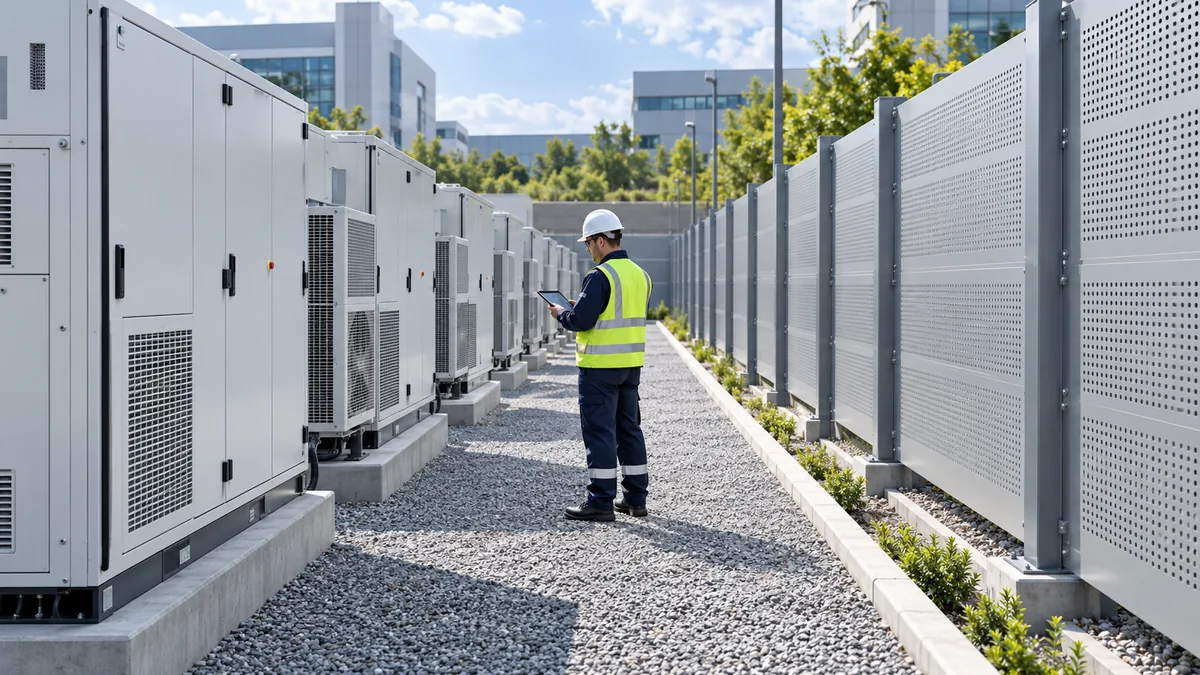
Ask whether reflections from the barrier, cabinet rows or nearby buildings affect other locations. An absorptive face may help in some layouts, but the facing, backing and environmental durability must be specified as a complete assembly. Perforated facing alone does not establish an effective acoustic barrier.
Coordinate foundations, wind loads, drainage and collision protection. Review the cabinet versus container layout checklist before freezing the wall position; equipment access and heat rejection can determine whether the proposed geometry is buildable.
5. Treat an acoustic enclosure as a complete system
A BESS acoustic enclosure introduces a new environment around equipment designed for particular ambient and ventilation conditions. Its openings, doors, roof, penetrations and internal airflow can dominate both acoustic and thermal performance. Specify how each opening will be treated and how maintenance teams will reach the equipment.
Obtain written review from the equipment supplier before adding an enclosure around a cabinet, PCS or cooling unit. Clarify whether the proposed arrangement affects warranty, certification scope, inspection requirements or the approved installation instructions. Approval of a panel material does not establish approval of the assembled enclosure.
Account for water ingress, condensation, drainage, lighting, isolation access and removal of major components. A removable panel needs a defined lifting method and space to use it. Compare the proposal with the outdoor AC cabinet cooling and enclosure checklist so noise treatment stays coordinated with the original equipment requirements.
6. Specify acoustic louvers and silencers with airflow data
A ventilation treatment creates resistance to airflow. Request the pressure drop at the actual design flow, frequency-dependent acoustic performance, dimensions and installation orientation. Generic claims such as “high noise reduction” provide little help if they omit airflow and test conditions.
The equipment supplier should check the fan's available pressure, the revised operating point and cooling capacity. Added resistance may change fan speed or create additional airflow noise. Where a hood or duct is proposed, review bends, transitions, intake separation and the risk of hot exhaust returning to the intake.
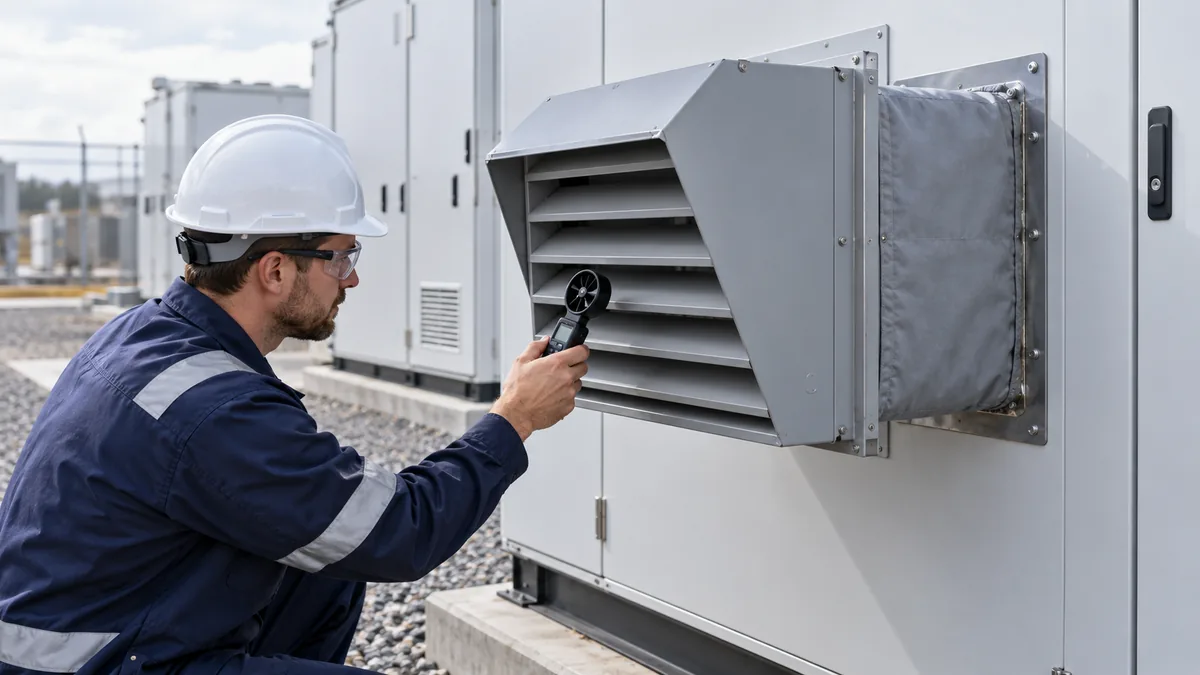
Include rain protection, corrosion resistance, cleaning access and replacement of damaged acoustic media. Debris or clogged screens can change the pressure drop over time. For equipment selection context, see the air versus liquid cooling comparison; either architecture can still have external heat-rejection equipment that requires acoustic review.
7. Check thermal performance in the demanding operating cases
Acoustic design and thermal review should use compatible operating assumptions. Include relevant high-ambient conditions, continuous charge or discharge, multiple cabinets operating together and any expected post-dispatch cooling period. A quiet short demonstration does not represent every permitted operating case.
Agree which temperatures, fan states, alarms and power limits will be logged during thermal verification. Check the supplier's clearance requirements against the final wall and enclosure drawings. Where modelling is used, record its assumptions and decide what site measurements will confirm them.
Follow the outdoor cabinet temperature and maintenance checklist when assigning ongoing checks. A treatment that passes on clean equipment may behave differently after filters, louvers or heat exchangers accumulate dirt. The handover should identify the maintenance condition on which the acoustic and thermal predictions depend.
8. Preserve safety functions and service access
Map the treatment against emergency access, isolation points, detection equipment, designed discharge or relief paths and the space needed for inspection. Do not route ventilation through an acoustic assembly without checking how it interacts with the installation's safety design. Doors and removable sections must support both routine work and the agreed emergency response.
NFPA 855 addresses hazards associated with stationary energy storage systems. The edition and requirements adopted for a project depend on the jurisdiction. It provides safety context, not a site-specific acoustic limit or automatic approval for a retrofit.
Bring the acoustic drawings into the project's fire and installation review. Use the BESS fire safety document checklist to organize the relevant records. Obtain written decisions from the responsible designers and authority where required before construction closes access routes or changes enclosure conditions.
9. Define any noise-limited operating mode
Controls can contribute to noise mitigation when the supplier supports a suitable mode. Examples may include dispatch scheduling or a defined power limit during sensitive hours. Every restriction needs a clear relationship to cooling demand, battery condition and the site's required energy service.
Do not assume that reducing electrical power immediately eliminates fan noise. Cooling can continue after a dispatch event, and high ambient temperature may require substantial cooling at lower power. Ask for data describing the proposed mode and the conditions that override it.
Record start and end times, permitted power, control ownership, alarm behaviour and any commercial consequences. If the acoustic prediction relies on an operating restriction, include it in acceptance and handover documents. The owner needs to know which later configuration changes require a renewed acoustic review.
10. Put performance and responsibilities into the tender
Send bidders the receptor map, source schedule, operating cases, proposed layout and applicable assessment requirements. Ask each bidder to state which sources and paths are covered, what information remains missing, and what assumptions could change the result. Distinguish laboratory panel data from predicted performance of the installed site.
- Require drawings showing wall ends, gates, openings, foundations and equipment clearances.
- Request thermal compatibility evidence and written equipment supplier review.
- Specify corrosion, drainage, cleaning and acoustic-media maintenance requirements.
- Assign responsibility for prediction, installation inspection, testing and corrective work.
- Define acceptance criteria, test conditions and the response to an unsuccessful test.
Use the C&I ESS site survey checklist to fill information gaps before comparing prices. Quotes based on different receptor locations or operating assumptions are not directly comparable.
11. Verify the installed treatment and retain a baseline
Inspect the finished treatment before acoustic testing. Check panel alignment, joint seals, gates, penetrations, clearances and ventilation assemblies against the approved drawings. Record deviations and close them through the responsible designer. Photographs help document details that may be hidden later.
The acoustician should define measurement locations, instrumentation, weather suitability, background treatment and the equipment states needed for acceptance. Log dispatch, fan operation and temperature during testing so the result can be linked to a known operating condition. Use equivalent conditions for a before-and-after comparison; otherwise the apparent difference can reflect changed background or equipment operation.
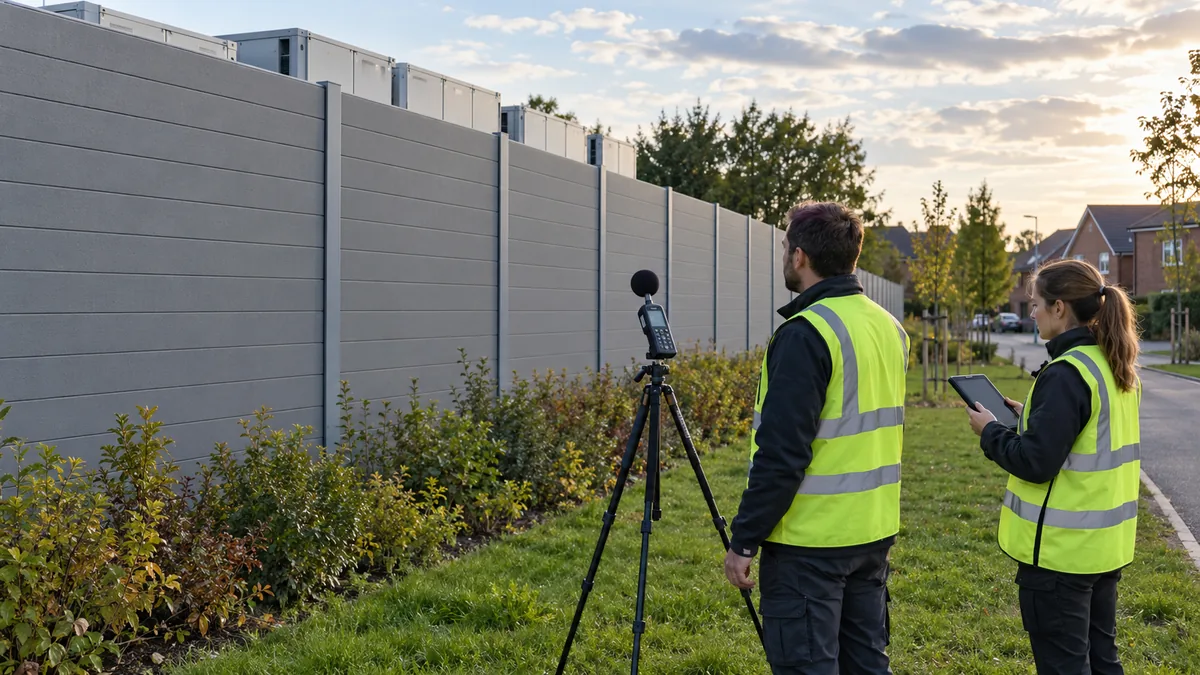
If a criterion is missed, investigate the dominant source and escape path before adding more material. Retest the agreed conditions after corrective work. File acoustic results, thermal logs, approved drawings and operating restrictions with the ESS commissioning and handover records. Later complaints can then be checked against an established baseline.
12. Frequently asked questions
Is a BESS acoustic barrier the same as an acoustic wall?
Both terms commonly describe a screen placed between equipment and receptors. Its effectiveness depends on geometry, continuity, source frequency and reflections. The name alone does not establish installed performance.
Can an acoustic enclosure be added to any battery cabinet?
No universal retrofit assumption is reliable. The equipment supplier and responsible designers need to review cooling, ventilation, safety functions, service access and warranty implications for the proposed arrangement.
How many decibels will a BESS noise wall reduce?
There is no single reduction that applies to every installation. Ask for receptor-specific predictions using the actual sources and layout, then verify the installed result under the agreed operating and measurement conditions.
Does a quiet mode remove the need for physical treatment?
It depends on the source behaviour, permitted operating cases and local criteria. A quiet mode may help, but its thermal limits, cooling after dispatch and effects on energy delivery need review before the project relies on it.
Planning commercial or industrial battery storage near sensitive neighbours? Review SolarStorageHub's C&I energy storage options and share the site layout and operating requirements so equipment selection and the project's acoustic design can be coordinated.
Related SolarStorageHub Resources
If you are turning this article into a buying decision, compare the relevant product families and send your inverter model, target capacity, installation country, and quantity plan for confirmation.